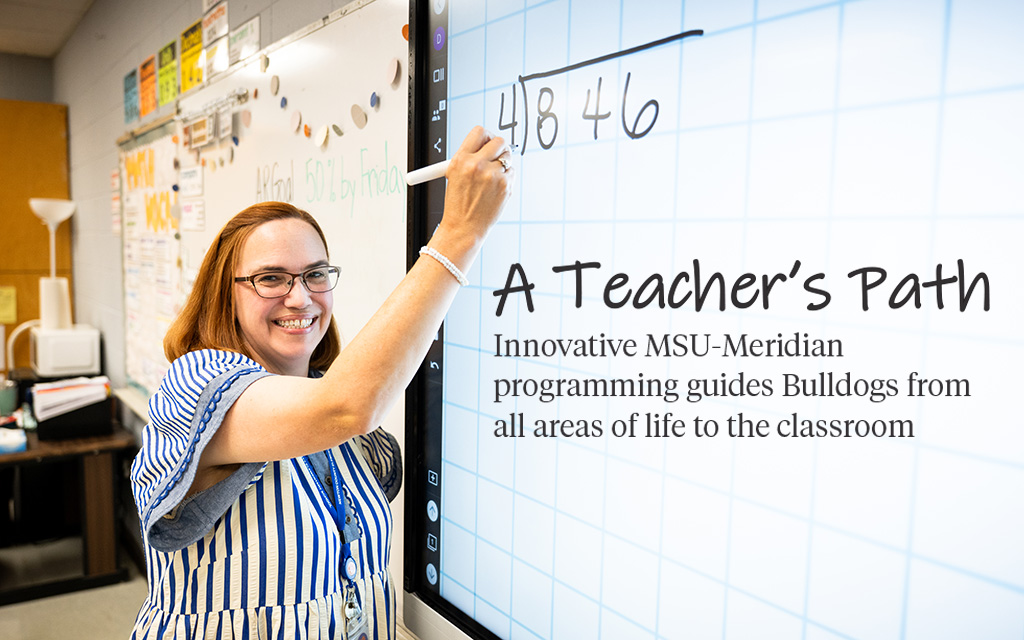
Innovative MSU-Meridian programming guides Bulldogs from all areas of life to the classroom
Despite years of experience in educational settings, Daveyel Smith says she couldn’t have become a licensed teacher without the help of an innovative Mississippi State-Meridian program and a Bulldog alum giving back to nontraditional students.
Smith, a mother of three, left her career as a customer service representative decades ago, instead opting to work in church and private prekindergarten programs to be closer to her own children.
Then, in 2018, she joined Newton County Elementary School as a teacher’s assistant, where her dedication to students caught the attention of her principal. She soon was asked to help with Tier-3 tutoring—a level of educational intervention requiring intensive, one-on-one support for those with significant challenges. This shift not only changed the trajectory of her students’ lives but for her life as well.
“At first, I thought that kind of tutoring was hard and not for me, but that’s where I found my passion—my true place to be,” she said. “That’s when I knew I had to go back to school.”
When she set that goal, Smith found herself faced with the dilemma many teacher assistants and substitutes encounter: She needed a bachelor’s degree and state licensure to become a teacher, but she couldn’t afford to quit her job to focus on college.

That’s when she discovered MSU-Meridian’s Professional Advancement Network for Teacher Assistants, or PANTA, which allows working students the flexibility to keep their jobs while pursuing a degree through evening or online classes. A key feature of the program allows these teacher assistants to apply their job experiences toward credit in a variety of MSU classes, meaning what they do for a living not only matters to them and their communities, but it also counts academically.
“I put it off for years. As a mom of three, there was no way I could afford to not work. Like everyone else, our family needs both of our incomes to survive,” Smith said. “If I had quit to go back to college, not only would I lose my job and seniority but there was no guarantee I could get my position back or be hired by another school district immediately.
“There was just no way I could have made going back to college work without the PANTA program,” she concluded.
Although Smith wouldn’t have to sacrifice her income to go back to school, she still worried about her family’s budget. When she enrolled in 2024, Smith was preparing for her daughter’s wedding and hoping to avoid taking out loans to float through what would become an expensive season in her family’s life.
A new opportunity presented itself: The Bebe Freeman PANTA Teacher’s Assistant Annual Scholarship. Established by Harry Freeman of Memphis, Tennessee, the scholarship memorializes his late wife—an educator who taught in public schools for more than two decades. The award provides $2,000 to recipients who have exhausted other avenues of financial aid.

Bebe Freeman, a longtime public school educator, is remembered through the scholarship established in her honor by her husband, Harry Freeman. The scholarship supports working teacher assistants pursuing their degrees and teaching licensure through MSU-Meridian’s PANTA program.
“It’s hard for some of these small school districts across the state to attract new teachers,” Freeman said. “There are already established teacher’s assistants in these districts who can almost double their income just by moving to a lead teaching position with the right education. I wanted to make sure there was an opportunity for these people with real experience to get a chance to make that leap.”
More than 30 years after finishing high school, Smith graduated this spring with a bachelor’s degree in elementary education. Now, instead of assisting other educators, she is a fifth-grade inclusion teacher at Newton County Elementary School.
“I believe God put me here specifically to work with children with challenges; to be someone who builds relationships with them and meets them where they are,” Smith said. “Teaching really is all about giving compassion and understanding.
“I had one student who struggled for weeks on phonetics, specifically with making the sound for the letter M. When he finally got it, we both stood up and did a happy dance,” she continued. “It’s those lightbulb moments that just mean so much to me. Paychecks are great, but that feeling is the true reward.”
In June, MSU-Meridian hosted a reception for Smith and the six other PANTA program graduates who received the Freeman Scholarship. Before the event, Freeman wanted to gift each graduate with their own MSU sweatshirt. He asked them to pick one out, and he had the memento shipped to their homes.
“Receiving that scholarship was huge. We’re a two-income household with only one child at home, so I didn’t qualify for a lot of support,” Smith said. “It was so nice to meet Mr. Freeman at that breakfast, thank him in person and let him know how much it meant to me.
“Every time I put that sweatshirt on, I think of Mr. Freeman and MSU—the impact they made in my life and on my career,” she explained. “I’m planning to continue my education in the future, too. I don’t know what the next step is just yet, but I do believe there is one coming and that’s because of MSU.”
‘What we should be about’
For Kim Hall, College of Education associate dean and head of the Division of Education at MSU-Meridian, success at her job means hitting clear goals: Don’t just have students enroll in education programs and classes; instead, remove barriers to education, provide multiple pathways to obtain teacher licensure and turn Bulldogs into lifelong teachers who serve the Magnolia State.
“I believe in Mississippi State’s land-grant mission of truly serving our state, and that includes providing many different opportunities to become a licensed teacher who stays here,” she said. “If we just graduate students who leave, then we haven’t really made a difference in Mississippi. Through our programs, we’re really emphasizing community connection and service. To me, that’s what we should be about.
“PANTA is a huge success because these teacher assistants and substitutes are already committed to their communities and schools. Their district administrators love it when they hear one of their own is joining the program. They know they’ll become a great teacher who will stay and make their home a better place,” Hall explained. “This is who we’re looking for—those wanting to make a difference in their own communities, who just need a little help to do it.”
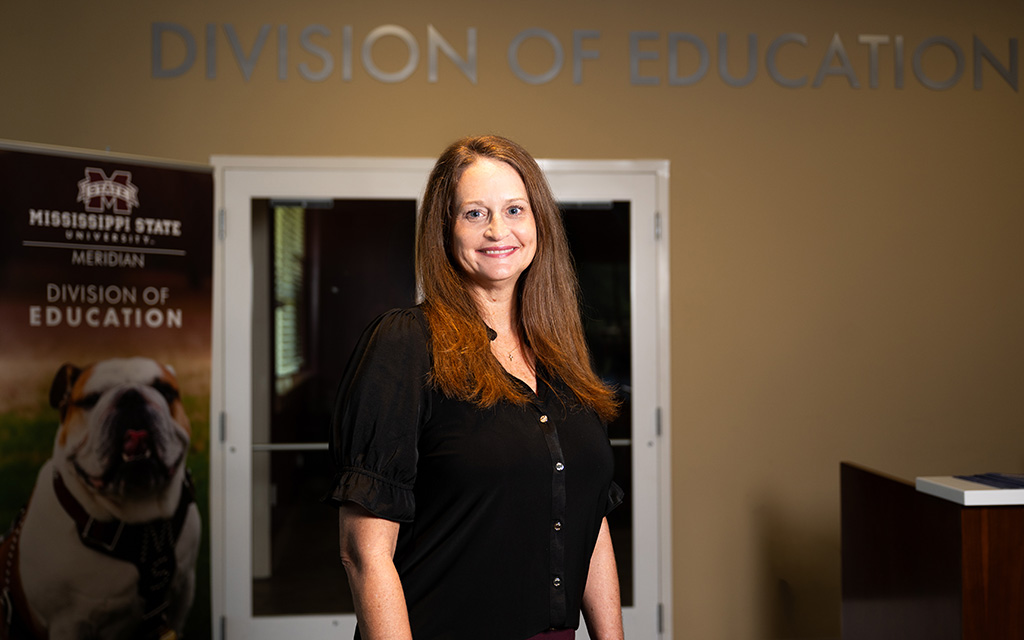
The PANTA program, which currently has 38 enrolled undergraduates, is just one of many ways MSU is providing pathways to teaching for both traditional and nontraditional students.
Last year, MSU received a $1.2 million grant from the Mississippi Department of Education to fund the Mississippi Teacher Residency program, which financially supports students looking to obtain teaching licensure or established teachers seeking supplemental endorsements in elementary or special education. Enrollees receive financial support for tuition, testing fees and other expenses, while MSU-Meridian connects them with established mentor teachers, supports professional development and pairs them with a Magnolia State public school district in need of educators.
MSU-Meridian also offers alternative-route master’s degree programs for those with degrees outside of education who are interested in teaching on the elementary or high school level. The respective 36- and 30-credit hour programs provide fast-track pathways, classroom experiences and graduate-level credentials to those looking to change their careers.
The alternative-route elementary degree program has graduated 72 students, many of whom were serving as teacher assistants. Its fall 2026 enrollment features almost 100 students—highlighting its rapid growth. The secondary alternate-route program at MSU has approximately 85 enrollees, including 24 in the fall 2026 group.
In addition to nontraditional students or those looking for a fresh start as a teacher, MSU’s College of Education also targets high-achieving high school graduates through the Mississippi Excellence in Teaching Program, or METP. Founded in 2013 by the Robert M. Hearin Support Foundation, this joint MSU-University of Mississippi initiative aims to prepare the state’s best and brightest for leadership positions in Magnolia State classrooms.
Enrollees concentrate on either elementary education; secondary English, mathematics or science; or special education. In addition to receiving funding for housing and dining, technology needs, professional development and a study-abroad opportunity, METP participants attend additional seminars and meetings and receive other support designed to enhance their educational experiences.
For these benefits, students commit to teaching in a Mississippi public school for five years after graduating, but this commitment can be deferred for graduate school.
“Connecting our future teachers to established mentors and each other is just the start of how we support them now and throughout their careers. If they’re supported, they’ll stay in the classroom longer and gain the institutional knowledge needed to support the next generation of teachers,” Hall said. “MSU is re-establishing the importance of teachers and their level of professionalism. When I see our graduates at conferences or see them win awards in their own districts, it lets me know we’re making a difference.”
Approximately 200 Bulldogs who went through the METP program are currently working in schools, and the program currently enrolls about 110 students, 36 of whom joined in fall 2026.
‘Best path possible’
Ginny Grace Brumfield says she always knew she wanted to teach.
As a child growing up outside of Tuscaloosa, Alabama, the self-described “lover of all things school” would pretend to teach in her own imaginary classroom.
“Instead of teatime, I would have class time. I even had a whiteboard, where I’d write out the day’s lessons,” she said. “From an early age, I knew exactly what I wanted to do. It’s a calling from the Lord, and there really wasn’t a time where I seriously considered doing anything else.”
The one thing she didn’t anticipate was where she would teach.
Brumfield is now in her sixth year at Clinton Public School District’s Northside Elementary after a four-year stint teaching second grade in Brandon.

Her Magnolia State career is due to the METP.
After earning her high school diploma with a 4.0 GPA and scoring a 31 on her ACT, Brumfield looked for higher education opportunities with enough scholarships to keep her out of debt.
“I applied to a lot of schools and prayed about it. I said, ‘OK, Lord, where you give me a full scholarship—that’s where I’m going to go. And that’s when he opened up this opportunity with MSU and the METP,” she said. “Between the full cost of attendance, technology stipend and the study-abroad funding, the scholarship was too good to turn down.”
Through the program, Brumfield said she had access to great academic classes and mentors who prepared the METP students for what it’s really like in the classroom. As an undergraduate, she was a College of Education Ambassador and volunteered in the office of MSU’s World Class Teaching Program, which supports students as they seek National Board Certification.
Brumfield, now a two-time MSU graduate, is certified in Early and Middle Childhood Literacy: Reading-Language Arts and serves as a mentor to others going through the process.
“When administrators see METP on a resume, they know they’re getting a good teacher,” Brumfield said. “These educators and mentors really made us the best teachers we could be. They were a built-in support system I knew I could talk to at any time, even to this day. They even came during the fall and spring semesters of my first year of teaching just to check on me—that’s how much support they offer.
“My time at MSU was incredible. Without METP, my life would look completely different,” she continued. “MSU offered opportunities to me I wouldn’t have had anywhere else, and the people you get to meet and interact with really make it the best path possible.”
By Carl Smith, Photos by Grace Cockrell
Building a Stronger Behavioral Health Workforce
The Robert M. Hearin Foundation remains one of Mississippi State’s greatest champions, supporting a variety of programs across numerous disciplines, from nursing to engineering.
In addition to providing a pathway to teaching for the best and brightest incoming freshmen for almost 15 years now, the organization also partners with the College of Education’s applied behavior analysis master’s program, preparing future Bulldogs for crucial roles in improving the quality of life of those diagnosed with autism spectrum disorder and other challenges.
With the Hearin Foundation’s support, MSU strives to employ additional clinical staff to support training programs and service delivery; increase supervised training experiences to students; decrease the bottleneck of ABA graduates needing to complete their supervised experiences required for state licensure as a behavior analyst; and increase the overall number of those entering the behavioral health workforce across the Magnolia State to meet ever-growing local demand.
MSU’s two-year master’s program accepts new cohorts each fall, and graduates are eligible to take the Behavior Analyst Certification Board exam needed to certify independent practitioners.
Founded in 1965, the Ridgeland-based Hearin Foundation supports numerous educational institutions and charities throughout Mississippi, focusing on education as the best pathway to economic prosperity for the Magnolia State.
In addition to numerous MSU programs, it has supported the Mississippi Museum of Art, Mississippi Symphony Orchestra Association, the Mississippi Opera Association and other state institutions of higher learning.