When you eat catfish, touch grass or watch a space vehicle take flight, you’re likely benefiting from the application of Mississippi State University intellectual property. From catfish vaccines and their delivery systems to popular Bermuda grass or software supporting NASA, Blue Origin and SpaceX, Bulldog ideas are found everywhere from under your feet to heavens above.
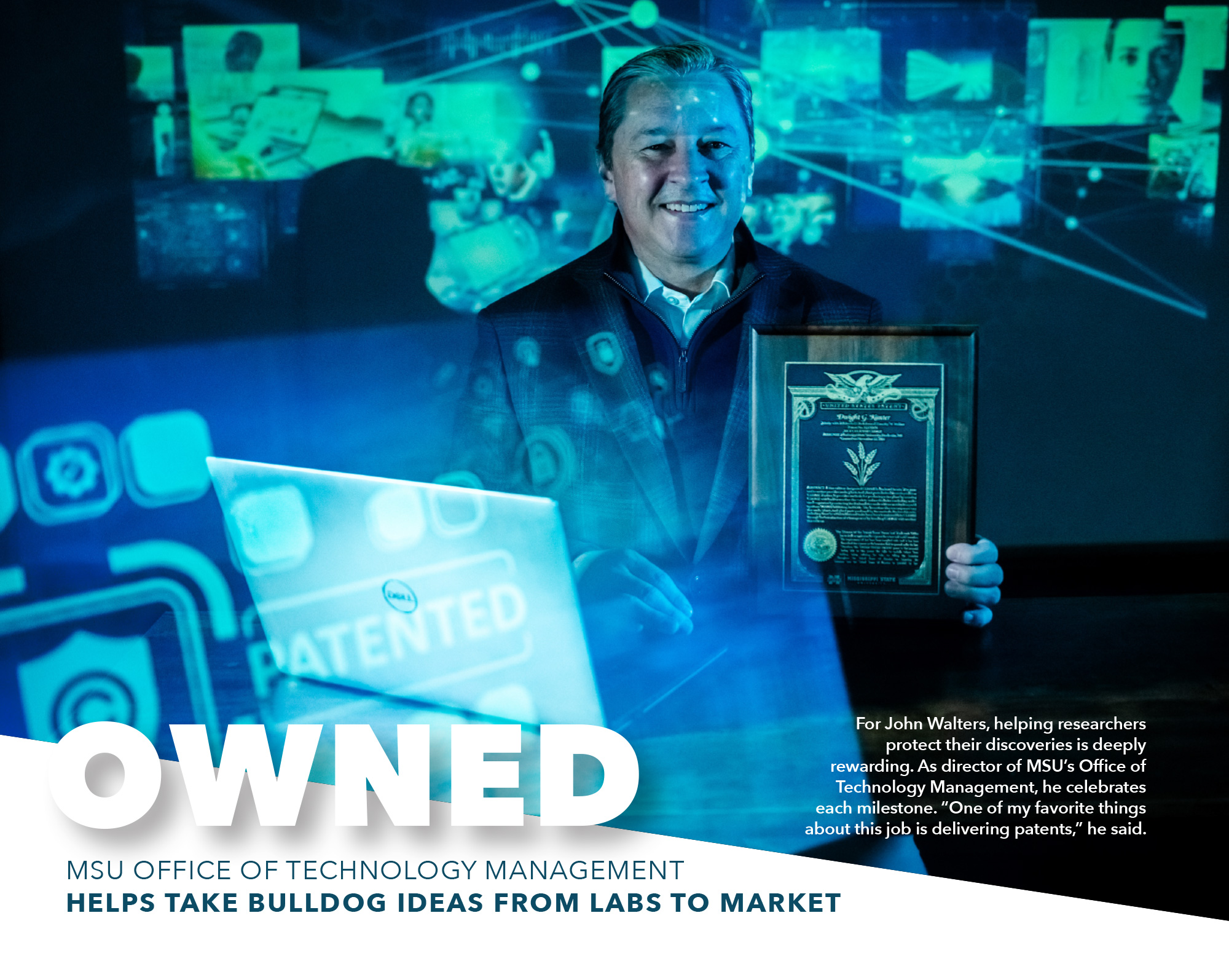
MSU is known across the globe for its cutting-edge research, and overseeing the idea-to-impact pipeline for students and faculty looking to change the world is the university’s Office of Technology Management. This unit and its dedicated staff handle all facets of taking innovation from laboratory to market. From helping acquire funding and securing patents to managing licensing agreements and royalty distributions, OTM works with researchers to ensure their ideas come to fruition.
“Everybody working at MSU has an impact on the world that can’t be overstated, whether that’s working toward ending food insecurity or helping protect our country and explore space. All of this has an enormous impact now and will for the foreseeable future,” said John Walters, OTM director. “MSU is focused on intentional, translational research like that. This isn’t just theory. These are practical, useful products that affect life as we know it.”
Currently, MSU has almost 300 active technologies, from patented blueberry and cotton varieties to an automated precision-hole poly pipe deployment system for field irrigation and metal additive manufacturing control software. Fiscal Year 2025 was historic for MSU innovation, as OTM helped facilitate a record 48 invention disclosures—one of the first steps needed to patent an idea. The office also helped file 20 patents and had four previous filings approved, marking the completion of what can be a yearslong process.
All of that intellectual property pays dividends for both the inventors and the university, which then uses it to spur future innovation.
“One of my favorite things about this job is delivering patents,” Walters said, “but another is when I can look at the accounts register and see those distribution checks going out to the inventors and their departments because those make a difference in their lives and help the university continue its missions of service and research.”
Walters explained OTM serves the university’s missions by taking some of the worry and red tape off the shoulders of campus innovators. By handling the procedural aspects of developing intellectual property, OTM enables researchers and scientists to focus on what they do best—creating innovative solutions to today’s and tomorrow’s problems.
As researchers work through their discoveries in the lab, OTM staff members begin the idea-protection process through disclosures and provisional patents. The office then initiates marketing and connection efforts in anticipation of licensing the product after the intellectual property is fully secured. In addition to billing royalties and collecting fees from companies licensing Bulldog inventions, OTM also assists researchers who take on the business side of their creations through spin-off companies.
“The metaphor I like to use for the entire process is based around a flywheel. Our researchers and research funding get the wheel spinning, and it’s our job at OTM to ask how we can help it spin even faster,” Walters said. “Once we get that momentum going, steel sharpens steel—others want to be at MSU because that’s where the cutting-edge research is happening.
“Alumni—especially those with their own companies—even take notice of what we’re doing, and that spurs more contributions, which in turn could lead to the next big discovery,” he added.
‘Grown all over the world’
When football fans think of MSU, they’re likely to imagine four quarters of hard hits and ringing cowbells. But those who manage sports facilities’ playing surfaces know MSU is synonymous with exceptional Bermuda grass.
Some of MSU’s most visible and well-known licensed intellectual properties of the last 50 years are varieties of grass found on home lawns and sporting venues across the globe—including Southeastern Conference foe Louisiana State University.
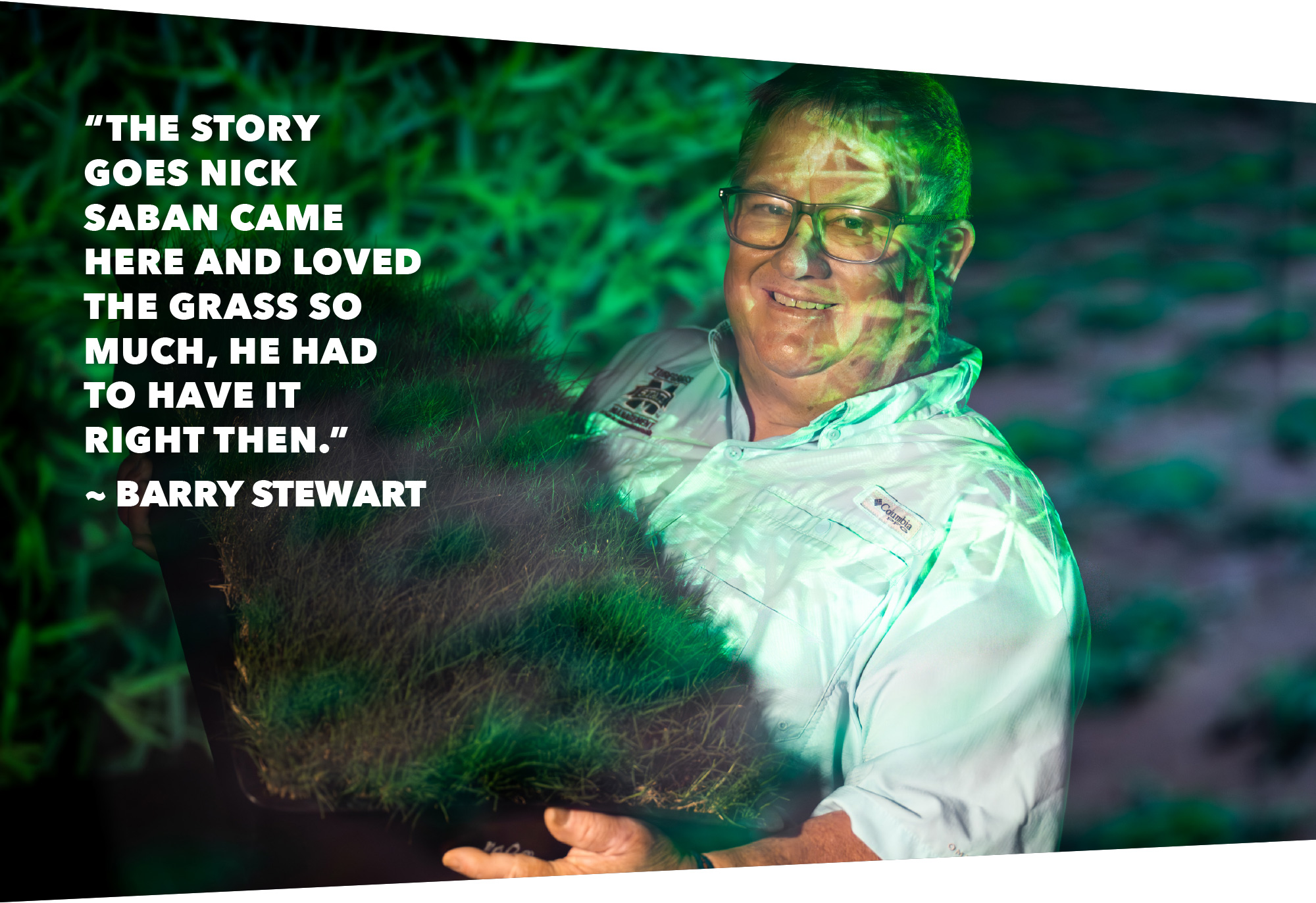
“The story goes Nick Saban came here and loved the grass so much, he had to have it right then. They built a little sod farm just to service Tiger Stadium,” said MSU Department of Plant and Soil Sciences Professor Barry Stewart.
That grass was MS-Choice Bermuda, which was known for its deep green color, canopy density and lateral growth. Many of the variants developed by MSU researchers show hardiness, resiliency and the ability to bounce back in tough conditions, Stewart said. In the West, where MS-Choice was marketed as Bullseye Bermuda, the grass found homes at Petco Park, the home of the San Diego Padres; Chase Field, the home of the Arizona Diamondbacks; and Rose Bowl Stadium in Pasadena, California.
From there, the grass took off like a weed. At one time, Stewart said, Bullseye was the No. 1-selling lawn grass in Phoenix, Arizona. Sod companies took notice and began working with the university on other Bermuda grass projects. For example, MSU and turfgrass research, development and marketing company Sod Solutions began a partnership in 2014 breeding new cultivars by cross-pollinating Celebration Bermudagrass with genotypes collected and maintained by the university. Celebration Hybrid Bermudagrass, the first cultivar from this project, debuted at the 2022 Turfgrass Research Field Day.
“MSU remains on the cutting edge when it comes to development of Bermuda grasses that not only do well here but beyond,” Stewart said. “It just goes to show the ideas grown here are grown all over the world.”
‘Balancing risk’
As an MSU doctoral student, Ed Luke created a virtual wind tunnel that would produce significant real-world impact.
Luke, a three-time MSU graduate, is the architect behind the open-source software Loci, which allows supercomputers to run a computational fluid dynamics solver known as CHEM. The Loci framework—logic programming for parallel computation field simulations—is used by NASA and SpaceX—among many others—to analyze rocketry and model vehicle components. NASA’s use of Luke’s work is extensive, as 30% of its Ames Research Center’s recent supercomputing hours used Loci codes.
Although his work was already in use at NASA, the space agency leaned heavily on Luke’s work following the 2003 Space Shuttle Columbia disaster. Supercomputers worked better with his software than others, he said, so NASA engineers began using it more for simulations as they worked toward reactivating the shuttle program.
“Wind tunnels are expensive and often can’t give you the exact information you’re looking for. That’s why we introduced a virtual model,” Luke explained. “There are errors we can eliminate from that virtual wind tunnel model that you can’t really eliminate from the actual tunnel, and vice versa.”
Eight years after the Columbia disaster, Luke’s Loci/CHEM software would again feature in a battery of NASA studies determining if Space Shuttle Endeavor sustained heat shield damage after launch debris struck the craft. Engineers wanted quick analyses, and his software was up to the challenge.
“Engineering is all about balancing risk,” he said. “Decisions are never based on one thing or test, but it helped narrow uncertainty when time mattered.
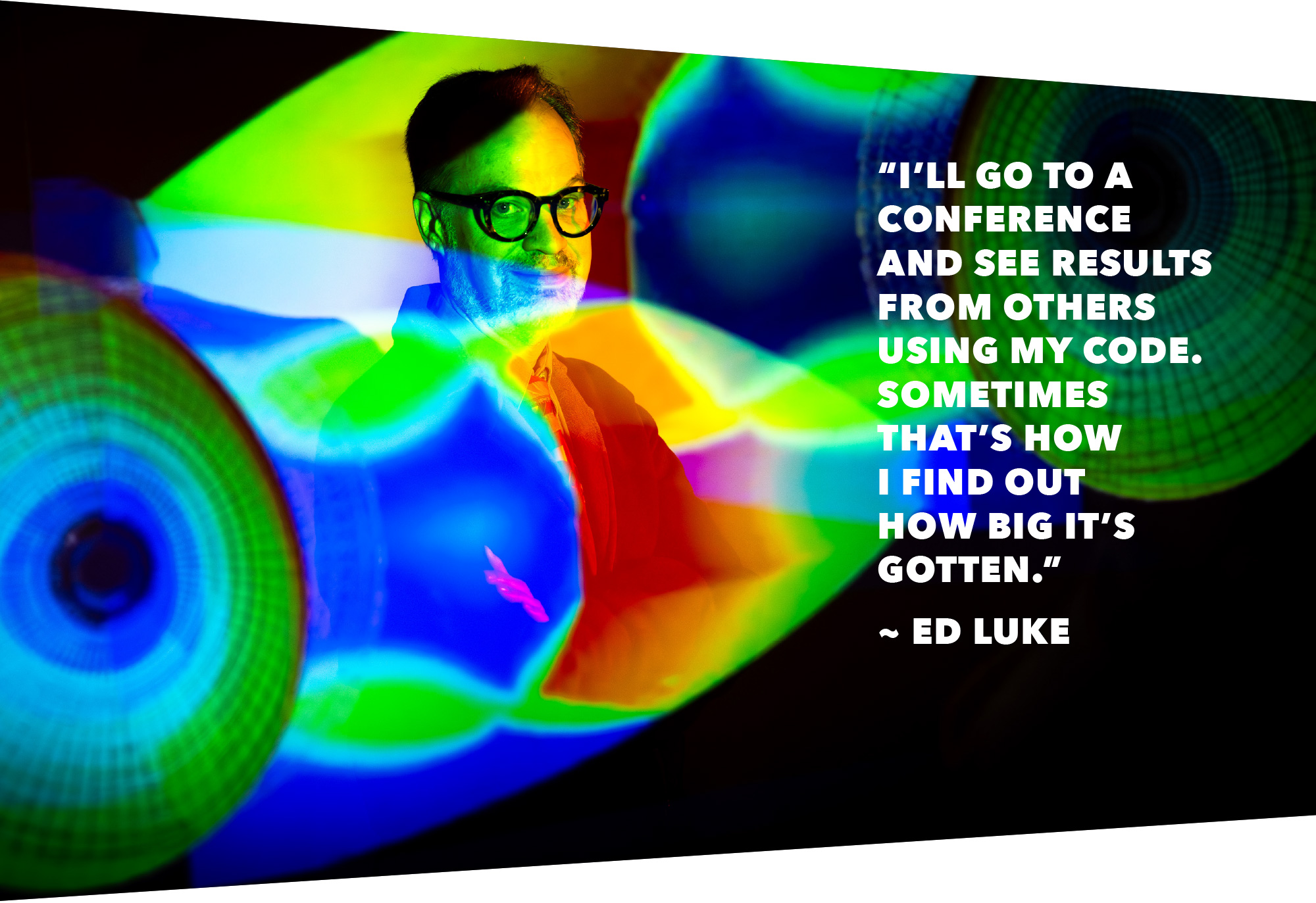
“I’ll go to a conference and see results from others using my code. Sometimes that’s how I find out how big it’s gotten,” Luke continued. “I’ve seen plenty of resumes from applicants who list knowledge of my software as a bullet point, and I see a lot of presentations at aerospace conferences using my code to do analysis. It’s pretty cool.”
Although the open-source software hasn’t generated licensing revenue from commercialization, Walters said it’s helped bring significant sponsored research funding and services revenue to the university through the years. Its widespread use has made it a highly impactful MSU-developed intellectual property.
“We want to build on that success, so the university is creating a sustainability plan from an open-source ecosystem perspective, so the software can continue to grow and live on,” he said.
Support for ideas
When a graduate student working under the supervision of Colleen Scott accidentally spilled a bit of slightly altered synthetic polymer known for its durability and strength, he spurred what might be the commercialization of a new, bio-based adhesive.
“He came back, and the container was stuck to the table,” explained Scott, an associate professor of chemistry who researches the synthesis and characterization of organic materials. “He figured out how to remove it and ran tests on it.
“That’s when we realized it had a reversible bond, meaning that if you glue something together, you can break it apart, put it back together, reheat it, and it heals itself—the bond reforms,” she continued.
The research lay dormant for years after the graduate student left, but a conversation with OTM facilitators is giving it new life. Thanks to the office, Scott is receiving funding through Strengthening Mississippi Academic Research Through Business Act, also known as the SMART Act, to hire another graduate researcher and continue the project.
“I always knew the project was a good one, but I just didn’t have the bandwidth for it without some help,” she said. “It addresses a niche area. While it may not revolutionize the industry per se, there are people out there who want it because it’s a plant-related creation, not fossil-fuel based.”
The SMART Act serves three principal goals: stimulate private investment in research and development through partnerships with Mississippi’s public colleges, increase the competitiveness of Magnolia State companies and improve the statewide economy.
While the SMART Act provides tax rebates to private investors who fund qualified research, its Accelerate Initiative gives direct disbursements of up to $150,000 to researchers performing validation testing necessary to transition state-owned intellectual properties into viable products and services.
OTM handles the selection and management of SMART Act funding and will assist Scott in preparing her research for commercialization as her testing works to replicate the accidental results.
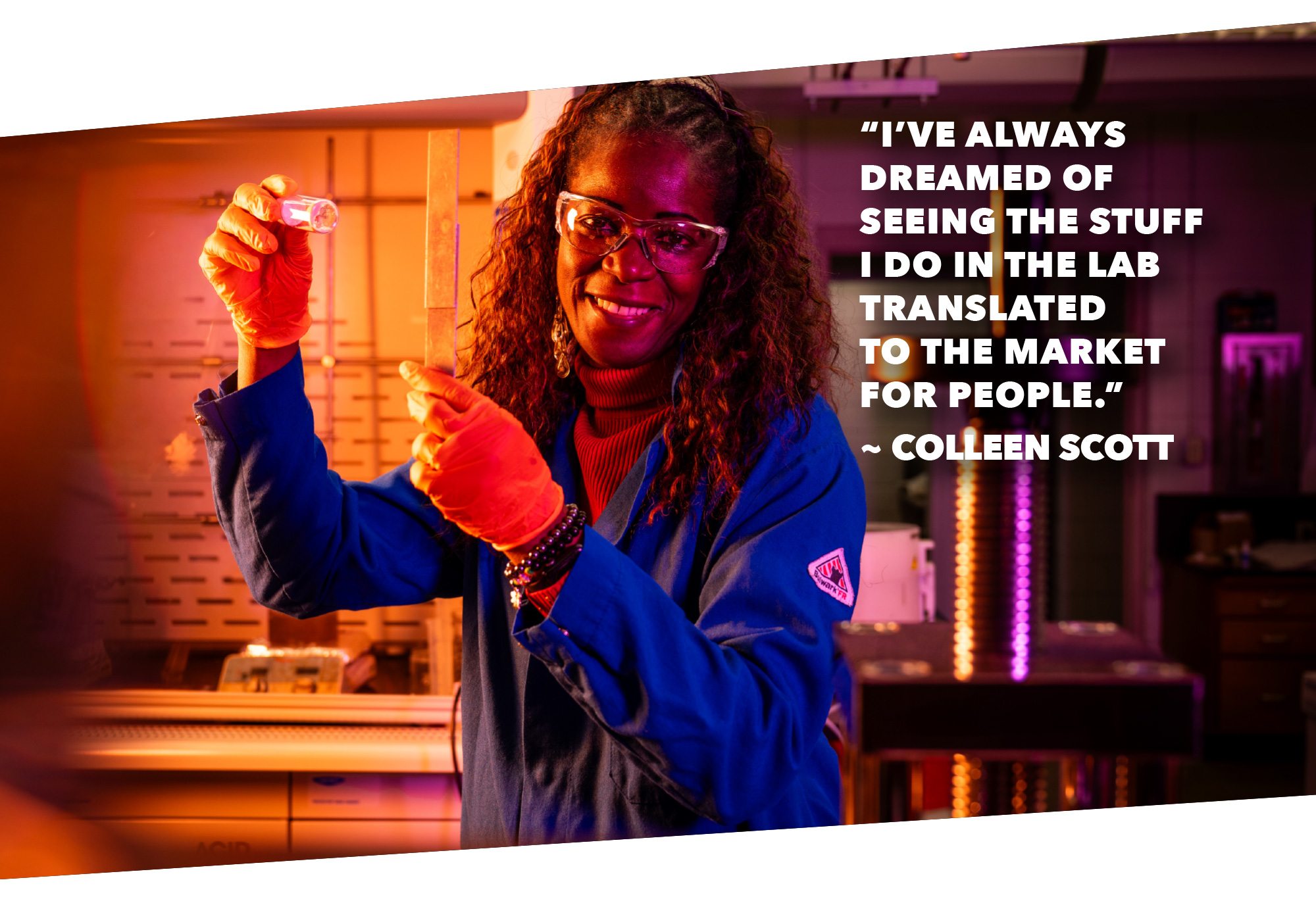
“I’ve always dreamed of seeing the stuff I do in the lab translated to the market for people,” Scott said. “It’s not about money for me; it’s always about science. That’s why I’m so grateful for OTM and how they come in and help with the business side.
“Researchers have ideas—that’s what we do. But for translation to happen, we need support, from OTM on the business side to our departments believing in what we’re doing,” she continued. “Having this ecosystem in place is invaluable, and that’s what’s helping me pursue my endeavors in terms of translational science that benefits society.”
By Carl Smith, Photos by Grace Cockrell