

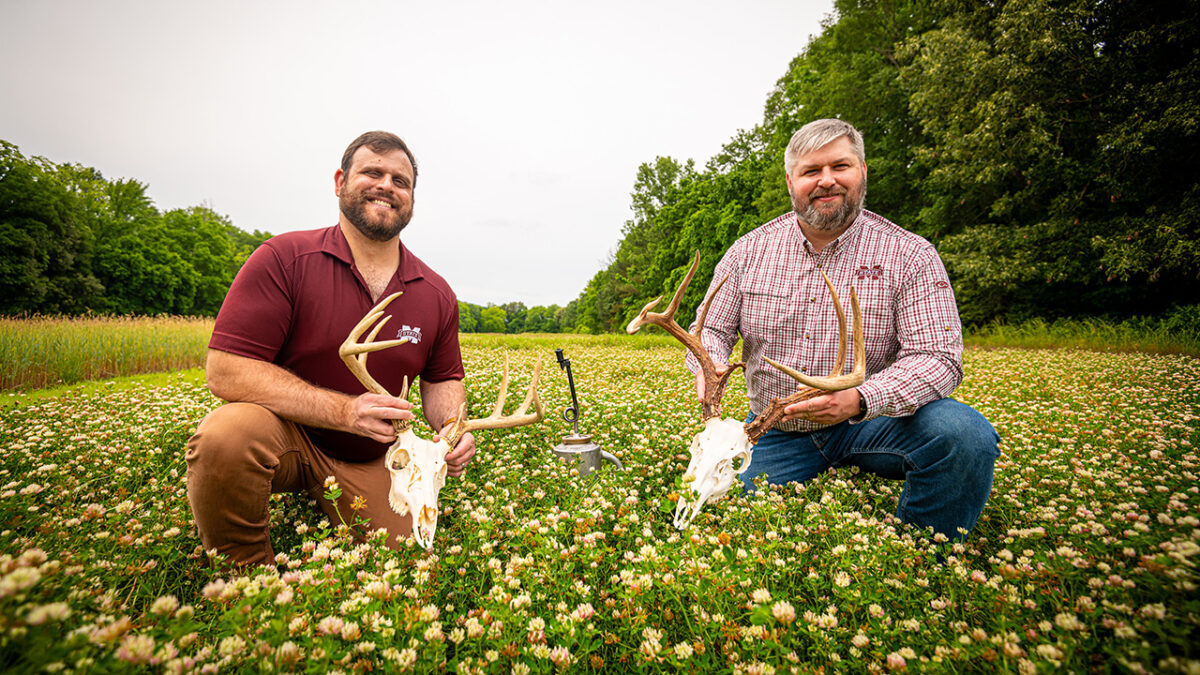
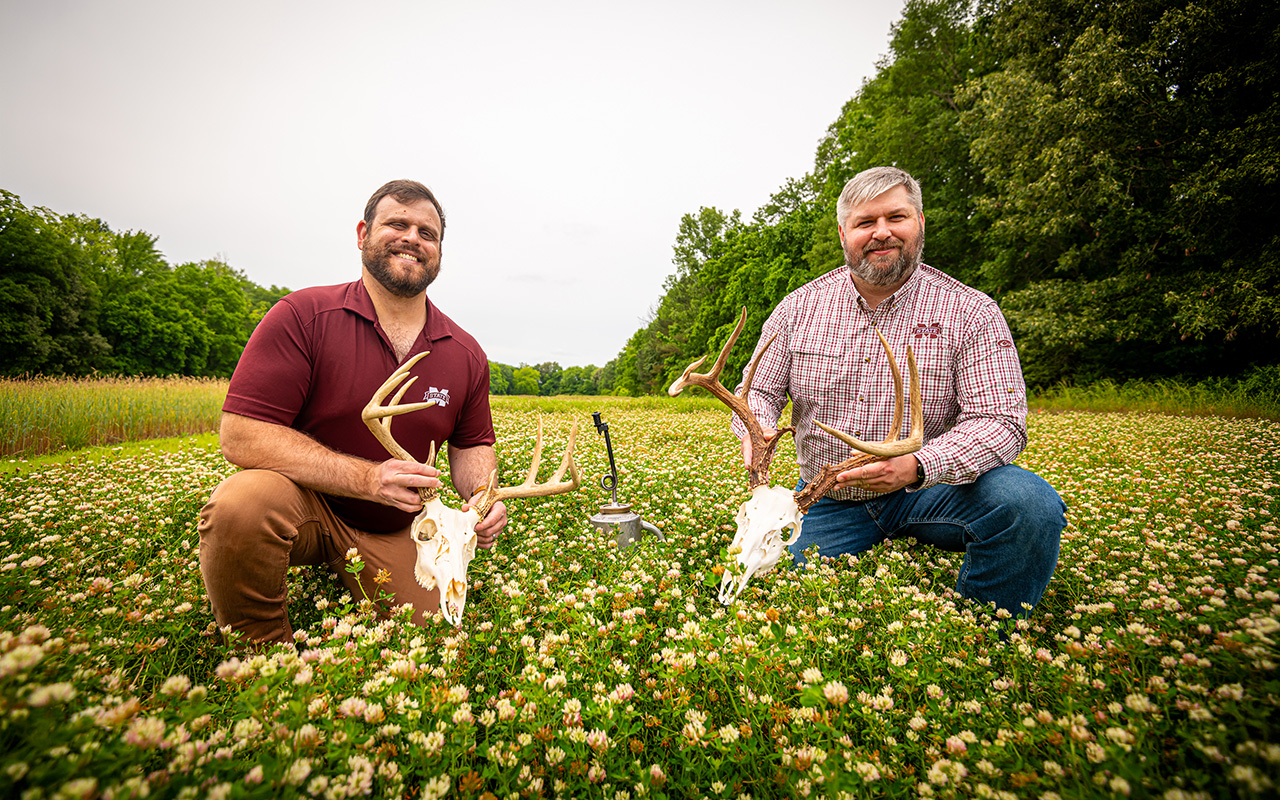
Eric Michel, left, and Jacob Dykes lead Mississippi State’s Deer Lab, a nationally recognized research program in the Forest and Wildlife Research Center celebrating 50 years of studying white-tailed deer. (Photo by David Ammon)
National leader studying South’s most significant wildlife species celebrates milestone
Deer hunting may happen in the fall, but any hunter will tell you it’s a year-round pursuit. Spring means post-harvest survey analysis and timber stand improvement. Summer includes prescribed burns and construction on blinds. Early summer and early fall are dedicated to deploying trail cameras and planting food plots. Late fall through January finds hunters spending as much time as possible in the woods, focusing on harvest.
The work of the Mississippi State University Deer Lab follows a similar rhythm. A unit of the Forest and Wildlife Research Center and the MSU Extension Service, the lab recently celebrated 50 years of continuous research, teaching and outreach dedicated to white-tailed deer—work that informs landowners, hunters and legislators while training a new generation of wildlife biologists.
For Steve Demarais, professor emeritus and former Taylor Chair in Applied Big Game Research and Instruction, the MSU Deer Lab represents a lifetime of work and a mission that has remained constant for five decades.
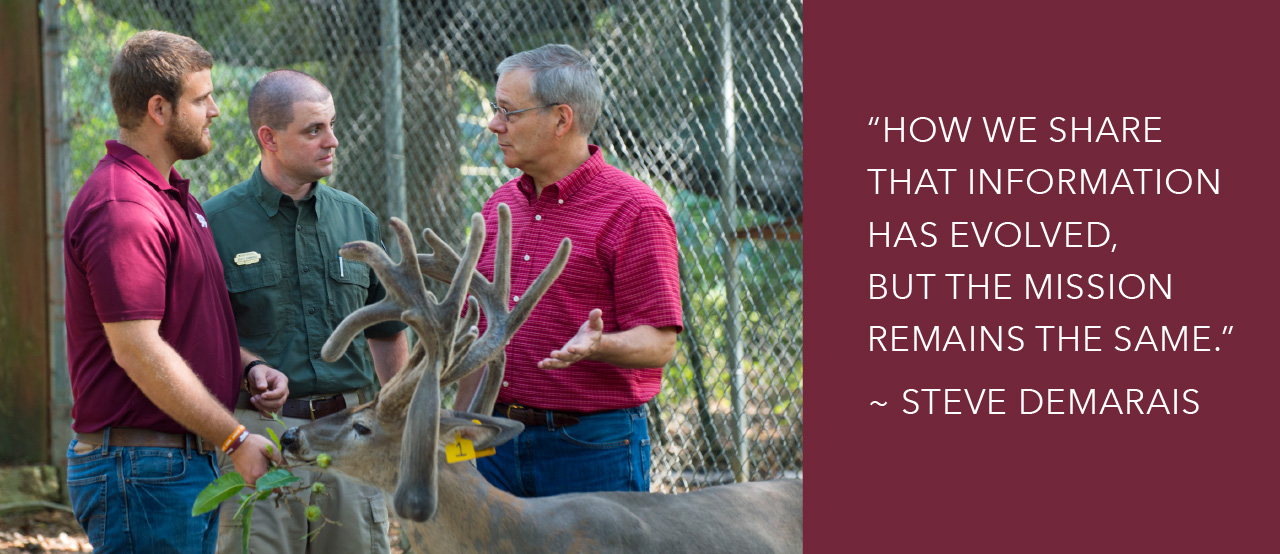
“Our mission is to address the informational needs of private landowners, hunters, state wildlife agencies and nongovernmental organizations oriented toward white-tailed deer,” he said. “How we share that information has evolved, but the mission remains the same.”
Demarais explained that white-tailed deer are the South’s most significant wildlife species.
“White-tailed deer hold immense cultural, recreational and economic value,” he said. “Deer hunting is one of the few activities where multiple generations of a family participate together. Hunting also pays for conservation, and nearly everyone who hunts participates in white-tailed deer hunting.”
Homegrown leadership
The lab’s leadership reflects a rare continuity built through mentorship. Demarais, who retired in 2025 after nearly 30 years, studied under founding director Harry Jacobson, earning his master’s and doctoral degrees in the 1980s. Bronson Strickland, the retired St. John Family Endowed Professor of Wildlife Management, studied under Demarais in the early 2000s before leading the program alongside him for 25 years. Today, Eric Michel, a former student of Demarais, and Jacob Dykes, who studied under Strickland, carry that legacy forward. Together, they lead the lab’s research and outreach efforts and serve as coordinators associated with the Taylor and St. John Family endowed positions.
While the lab is one of the premier deer research centers in the U.S., Michel said all the unit’s research has roots in benefiting the Magnolia State’s outdoors enthusiasts and its more than $1 billion annual deer-hunting industry.
“All the research we do is applicable to Mississippians,” Michel said. “We work closely with the Mississippi Department of Wildlife, Fisheries, and Parks as their research arm to deliver usable products that can be implemented directly into deer management.”
Dykes said the work reflects Mississippi State’s land-grant mission.
“One of the university’s core goals is ensuring education reaches beyond the classroom,” he said. “Knowing our research is applied and used across the state and beyond motivates us.”
A thriving habitat for research
FWRC scientists have produced some of the nation’s most influential deer research of the last 50 years, including pioneering the Deer Management Assistance Program and redefining how genetics, nutrition, age and habitat interact to shape antler development, behavior and breeding in white-tailed deer. Long-term studies have also advanced understanding of deer movement, dominance, multiple paternity and chronic wasting disease, including early environmental detection methods and findings that highlight the risks of artificial congregation at feeders.
In addition to studying the health, habitat and harvesting of deer, the lab also explores how to protect the state’s cash crops. One study evaluates repellents meant to reduce deer-related damage to soybeans, one of Mississippi’s most valuable crops.
Training tomorrow’s leaders
Student training remains central to the lab’s mission. Graduate students gain hands-on experience that extends well beyond the classroom, from prescribed fire and habitat management to field sampling and data analysis. The lab currently hosts two doctoral students, six master’s students and five undergraduate researchers. The team strives to ensure students have unique research opportunities.
“Experienced students often mentor newer ones in the field, exposing them to the full suite of habitat management tools used in the Southeast,” Michel said.
Collaboration also extends into outreach. Dykes holds an appointment with MSU Extension, helping translate research into practical guidance. Through nationally recognized outreach efforts, the lab shares its science widely via social media, videos, web resources and a top-ranked podcast, “Deer University,” that reaches millions each year.
The lab’s impact has earned national recognition, including the Boone and Crockett Club Conservation and Stewardship Award, as well as multiple lifetime achievement and applied research honors for faculty leadership.
On the horizon
The Deer Lab’s next chapter includes modernizing its 1970s-era facility to expand research and training capacity. Supported by a $1 million appropriation from the Mississippi Legislature in combination with private gifts, updated deer pens, improved handling systems and expanded workspaces will support advanced research in genetics, herd health, disease management, reproduction and technology-driven wildlife monitoring. To date, $750,000 in competitive funding has been secured, and the team has submitted an additional $2.5 million in grant applications to support the upgrades.
Looking ahead, Michel said collaboration remains the lab’s defining strength.
“Jacob and I work closely together across research, teaching and outreach. That teamwork is what moves us forward,” he said. “We also plan to extend our reach by collaborating more with researchers in other regions of the country. For example, bringing a Southeastern perspective on deer management to the Midwest and learning from their approaches in return can strengthen our work.”
Dykes said collaborating with constituents is also key.
“When we listen to landowners, producers and hunters, they tell us what problems they’re facing,” he said. “Those conversations shape our research. All we have to do is listen.”
By Vanessa Beeson, Photos by David Ammon & Russ Houston
Annual Deer Management and Hunting Calendar
While deer hunters spend most of the fall in the woods, effective deer management takes place year-round. This seasonal guide outlines key activities hunters and land managers can use to support healthy deer populations and improve hunting success during the fall.
FEBRUARY / MARCH
- Address closed-canopy forest conditions. Dense canopies limit forage availability. Hack-and-squirt or girdle-and-spray herbicide applications to select overstory trees can help open the canopy and encourage nutritious understory growth.
- Collect postharvest deer data. Review camera surveys and stand observations to assess herd composition and identify opportunities to improve habitat and management strategies.
APRIL / MAY
- Eliminate perennial grasses competing with desirable forage species.
- Establish warm-season food plots. Plant cowpeas and soybeans to support fawn growth and antler development during peak nutritional demand.
- Prepare for summer prescribed burns:
- Cut and clean fire lanes to bare soil and remove excess fuel
- Protect or remove equipment and clearly mark hazards
- Finalize burn plans, permits, weather conditions and crew availability
JUNE / JULY
- Contract with a certified prescribed burn manager to conduct prescribed burns when conditions allow.
- Address seasonal nutritional stress by promoting high-protein forage through food plots and habitat management.
AUGUST / SEPTEMBER
- Deploy trail cameras
- Analyze population data and identify management bucks
- Finalize harvest plans
- Conduct preseason surveys
- Assess antler development
- Estimate fawn recruitment
LAST WEEK OF SEPTEMBER / FIRST WEEK OF OCTOBER
Plant fall-season food plots
OCTOBER – JANUARY
The deer-harvest season offers opportunities for hunters of all ages and skill levels. Visit www.mdwfp.com/wildlife-hunting for current regulations and season dates.