

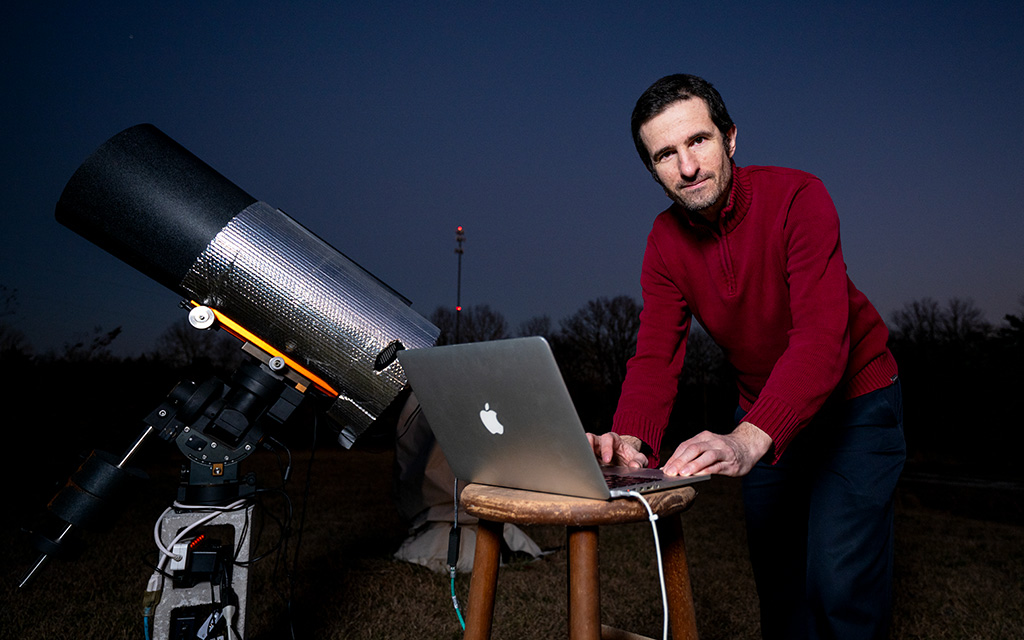
MSU professor’s backyard discovery puts Mississippi on the asteroid map
When Jean-Francois Gout missed discovering an asteroid by just a few days, the Mississippi State computational biology professor didn’t get discouraged. He used the near-miss to improve his focus.
“At first I was worried that it was just an artifact, dust on my lens or a reflection, but it was in fact an asteroid,” he said. “It was observed by a professional telescope in Hawaii first, so I didn’t get credit. Still, it made me realize what was possible. There was a chance I could discover something.”
Since then, Gout has kept his eyes toward the sky from his home observatory in the Oktoc community south of Starkville, searching for unidentified celestial bodies just waiting to be discovered.
His efforts paid off in January 2025 when he became the first person in Mississippi to identify an asteroid.
“I knew the odds were slim, and it felt like winning the lottery,” he said. “I was the discoverer, but it took a lot of time for it to become official. For me, this was a big deal.”
Gout has submitted another 10 observed objects since the 2025 find. The amateur astronomer and avid astrophotographer is awaiting final confirmation to determine if he will be credited for those discoveries as well.
A sense of wonder
There may not be a straight line between his academic career in computational biology and his hobby of astronomy, but Gout says the relationship is actually two-fold. Approached practically, the computer coding he writes to operate his telescopes allows him to practice and refine the code he uses in his research. On a more theoretical side, the two sciences satisfy—in different ways—his curiosity about the world.
“Curiosity connects us all,” said Gout, who is originally from rural France. “It’s good to stay curious and live that way.”
Recognizing how a sense of wonder has fueled and amplified his scientific endeavors, Gout created an astrobiology course at MSU that combines his love for astronomy with his work in biology.
“There are two big questions we try to answer in this class: How did life get started on Earth? And is there life elsewhere in the universe?” he explained. “No one knows the answer to these questions, but through this class, we can make an educated guess. I really love teaching that class.”
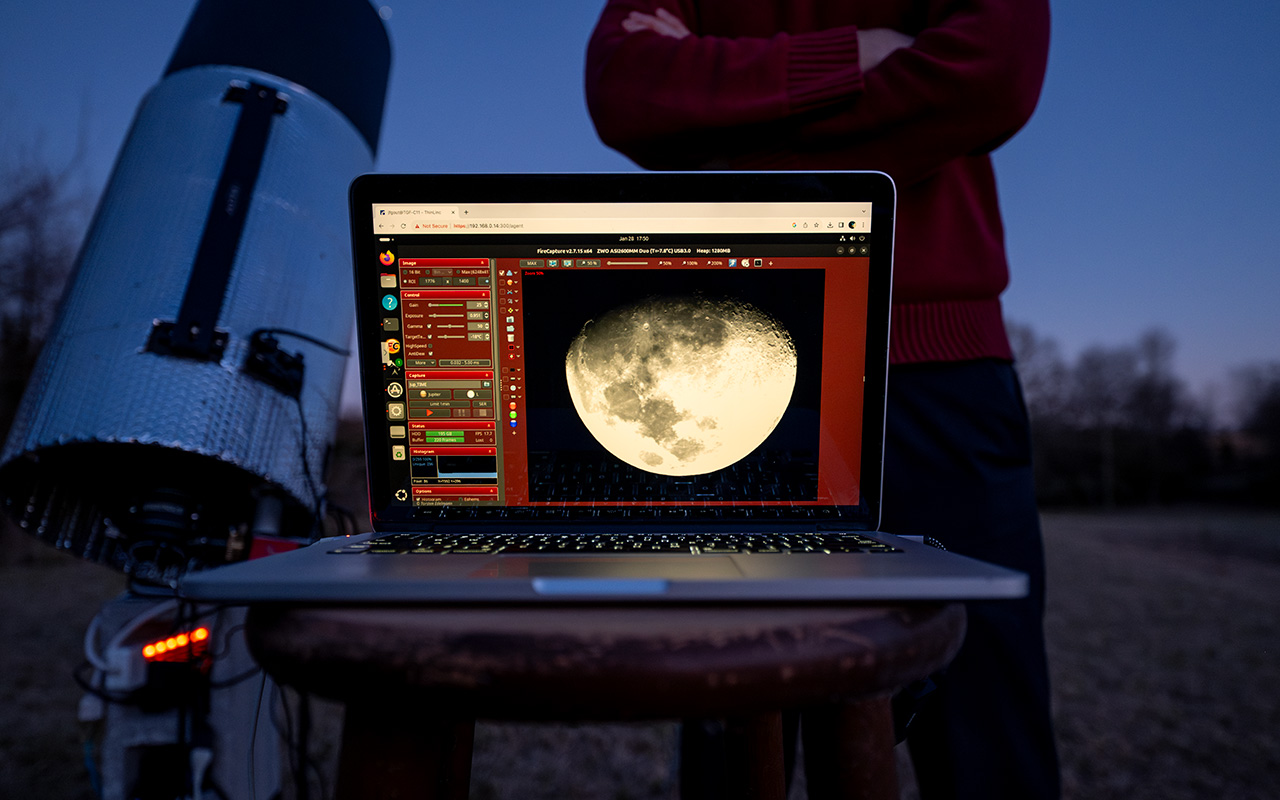
Jean-Francois Gout, a Mississippi State computational biology professor, photographs the night sky from his backyard observatory in the Oktoc community south of Starkville. A native of France, he carefully analyzes images for faint, undiscovered objects. In January 2025, he discovered the asteroid, a member of Jupiter’s Trojan family.
The right place for a historic discovery
When Gout and his wife, a fellow MSU computational biology professor, settled in Starkville, he had a couple of nonnegotiable requirements.
“I told my Realtor, ‘I want to live within 15 minutes of work, but far enough away to see the night sky without lights or trees blocking the view,’” he said with a laugh. “Where we live is perfect.”
His front yard has created the ideal environment to track celestial bodies.
“I program my telescope to take images of the sky every clear night while I’m sleeping,” he said. “With my breakfast the next morning, I pore through the images and data.”
It was this dedication that led to his first credited discovery: an asteroid of the Jupiter Trojan family, a rare group of objects sharing Jupiter’s orbit around the sun. Of the roughly 1.5 million known asteroids, only about 7,000 fall into this category. The discovery was confirmed by the Minor Planet Center, the world’s authority for verifying asteroid findings, operated by the Smithsonian Astrophysical Observatory.
Once the discovery was official, Gout proposed a permanent name to the International Astronomical Union. Because it belongs to the Jupiter Trojan family, the organization stipulates it can only be named after a Trojan war hero or an Olympic or Paralympic athlete.
The asteroid is now officially designated (826856) Commodorecochran in honor of the late Commodore Shelton Cochran, a 1923 MSU alumnus and the university’s first Olympic gold medalist. It is also a nod to Gout’s home country, which is where Cochran earned his gold medal at the 1924 Paris Games.
“I wavered between a couple of different options, but this being the first discovery from the state of Mississippi, I thought it would be cool if it was named after an athlete from Mississippi who also completed a first for the state,” he said. “It’s a really nice connection.”
Racing the future of astronomy
Gout’s achievement comes at a pivotal moment for amateur astronomy. With the Vera C. Rubin Observatory in Chile coming online with an advanced telescope scanning the entire sky every three days, future discoveries will become impossible for amateurs.
Still, he continues searching, hoping once again to spot something unique.
“I want people to see that I’m serious—that I’m legitimate,” he said. “I hope, in the end, to discover 30 or 40 more asteroids. It’s a crazy goal, but it’s my target.”
A childhood shaped by dark skies
Gout grew up about 100 miles south of Paris, far enough from city lights to experience a true night sky and for a fascination with astronomy to take hold.
“When I was 8, my grandfather bought me my first little telescope—a 60 mm refractor from a department store,” he recalled. “It was a good enough telescope that I could see the rings of Saturn and craters of the moon.”
The experience left a permanent mark. It’s what shaped Gout’s career and mindset of pursuing greatness—the same values he instills in his students.
“It changed my whole life,” he said. “That gift was such an important thing in my life. I hope everyone finds that—something that sparks their curiosity and gives them the courage to chase it.”
By Mary Pollitz, Photos by Emily Grace McCall
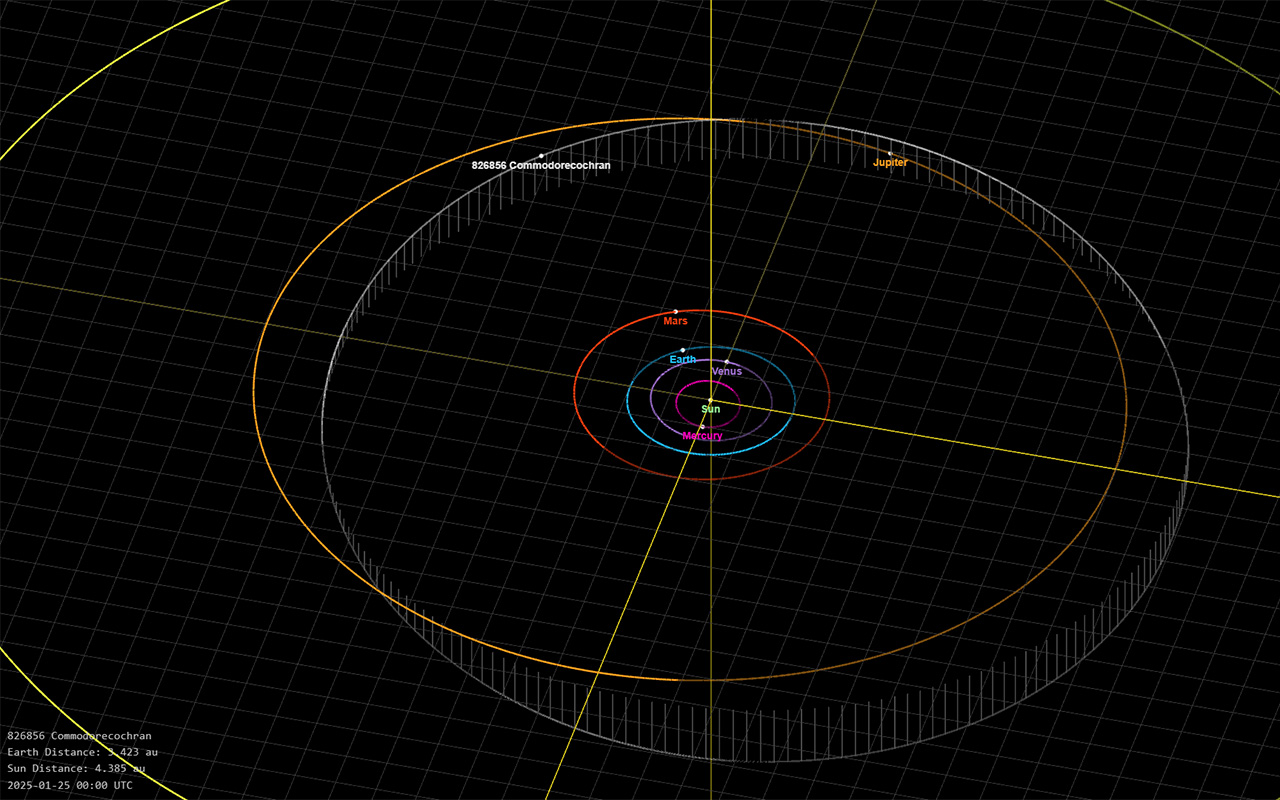
Part of the Trojan group that shares Jupiter’s orbit, asteroid (826856) Commodorecochran is the first asteroid discovered in Mississippi.