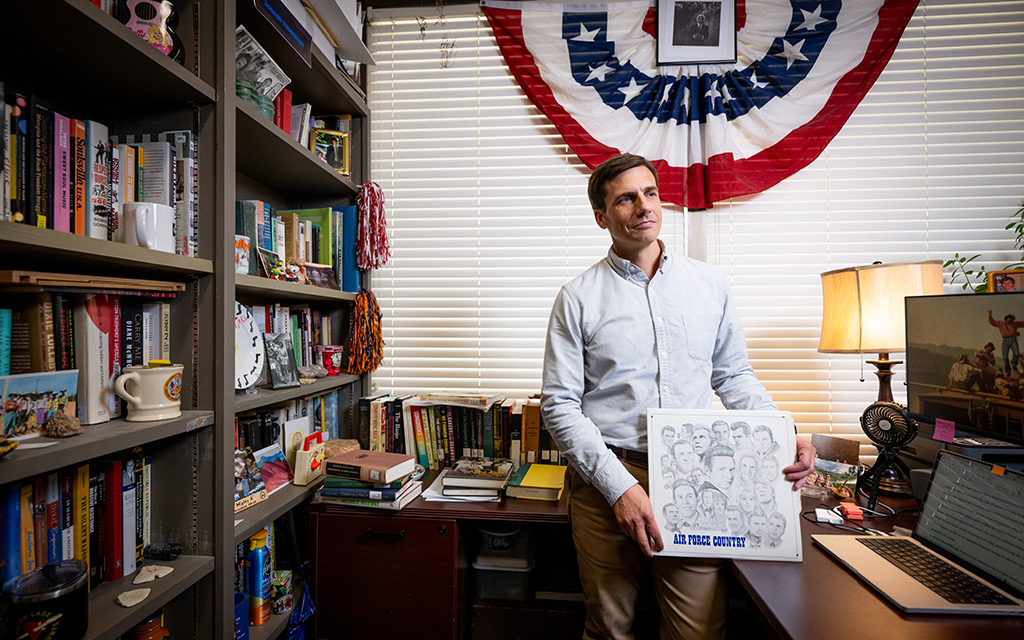
Thompson details Nashville’s influence on patriotism in award-winning book
Like most Southerners exposed to country music throughout their lives, Joseph Thompson knew of “Okie from Muskogee,” but his years of research into two of the South’s biggest cultural staples—a love of the nation and twang-filled tunes—would lead him to “Obie from Senatobie.”
Now an associate professor of history at Mississippi State, the Alabama native used that discovery and other insights into the South’s unofficial soundtrack to pen 2024’s award-winning “Cold War Country: How Nashville’s Music Row and the Pentagon Created the Sound of American Patriotism,” which details how culturally influential the intertwined country music business and U.S. government have been in the last century.
Thompson, who earned a Ph.D. and master’s degree from the University of Virginia and another master’s degree from Ole Miss, wanted to incorporate his love of music and the South into his graduate-level research. He grew up during the country music revival of the ’80s and ’90s, when Nashville produced powerhouse acts who would ride the genre’s wave into previously unseen commercial heights. This was a time when superstars including Garth Brooks, Alan Jackson and Billy Ray Cyrus were almost unavoidable on local radio stations, and cable broadcast stations The Nashville Network and Country Music Television would promote these artists to the entire nation—and world.
As with many creative movements and artistic genres, certain political and cultural stereotypes were tied to country music—both to its musicians and listeners—and how these assumptions formed always intrigued Thompson. His research on more obscure Southern musicians led him to O.B. McClinton, a Senatobia-based African American country artist who released “Obie from Senatobie” in 1973 as a response to Merle Haggard’s iconic 1969 song.
“The lyrics tell the story of McClinton joining the U.S. Air Force and paint a scene where the sergeant asks everyone where they’re from,” Thompson said. “All of these other guys are rounding up to the biggest nearby city, but he claims, in a very proud way, ‘I’m Obie from Senatobie,’ and really owns the small-town pride.”
As Thompson would discover, McClinton followed in a long line of musicians the Pentagon used to promote its branches. A recording of him on a USAF recruiting radio show piqued Thompson’s curiosity and led him to discover a treasure trove of similar shows for the Army, Navy and Marines in which the Defense Department paid Nashville studios and musicians to create recruitment programs for radio and television.
“These old country music shows gave me a clue that the music had something to do with the way Southerners perceived the military as part of their regional culture,” he said. “Country music isn’t the only reason why people have this pro-military viewpoint, but the transactional relationship between Music Row and the Pentagon does help explain both the politics and culture around it.”
Published by The University of North Carolina Press, “Cold War Country” would be named one of Rolling Stone’s Best Music Books in 2024 and a finalist for the Los Angeles Times Book Prize for History. One year later, Thompson brought home the Belmont University Curb Music Industry Award for Country Music Book of the Year at the International Country Music Conference.
In Rolling Stone’s review, Jonathan Bernstein said, “Thompson’s perspective-altering chapter on Elvis Presley alone makes this essential reading.”
“When we think of country music and patriotism, we instantly think of Lee Greenwood’s ‘God Bless the U.S.A.’ and Toby Keith in the wake of 9/11, but there’s also decades of history leading up to now in which the country music industry and the Department of Defense were intertwined,” Thompson said. “‘Cold War Country’ isn’t just a look at the music that influenced nationalism; it’s also about the characters who helped shape our views on the military, including Connie B. Gay, the founding president of the Country Music Association who helped link the music to the Pentagon, and Roy Acuff, who was huge for exposing the troops to country music through USO tours.”
Thompson said one of the most fascinating things about studying, researching and writing about music history is seeing how songs were written with an artist’s intention and then later co-opted into others’ ideologies or uses. Many tunes, from Woody Guthrie’s “This Land is Your Land” to “Okie from Muskogee,” he said, have been repurposed and reframed throughout the decades.
“That’s one of the fun and frustrating things about writing this history, because people assume they know what a song means and stands for, and they really lock into that. And if you, as a historian, are trying to tell them, ‘Well, here’s where they’re actually coming from,’ some just don’t want to hear it,” he laughed. “Music is produced in context of the times and with the artist’s intention. After a song—any art, really—is released, it’s out of the artist’s control.”
Fresh off the heels of the success of “Cold War Country,” Thompson said he is transitioning to a new project on nostalgia viewed from the lens of country music. He credits the MSU Department of History for allowing him “the time and intellectual freedom” to pursue his interests and churn out culturally impactful work.
“I’m writing about Jimmy Buffett and Kenny Chesney,” Thompson said. “How great is that?”
By Carl Smith, Photos by Grace Cockrell
‘CWC’ soundtrack
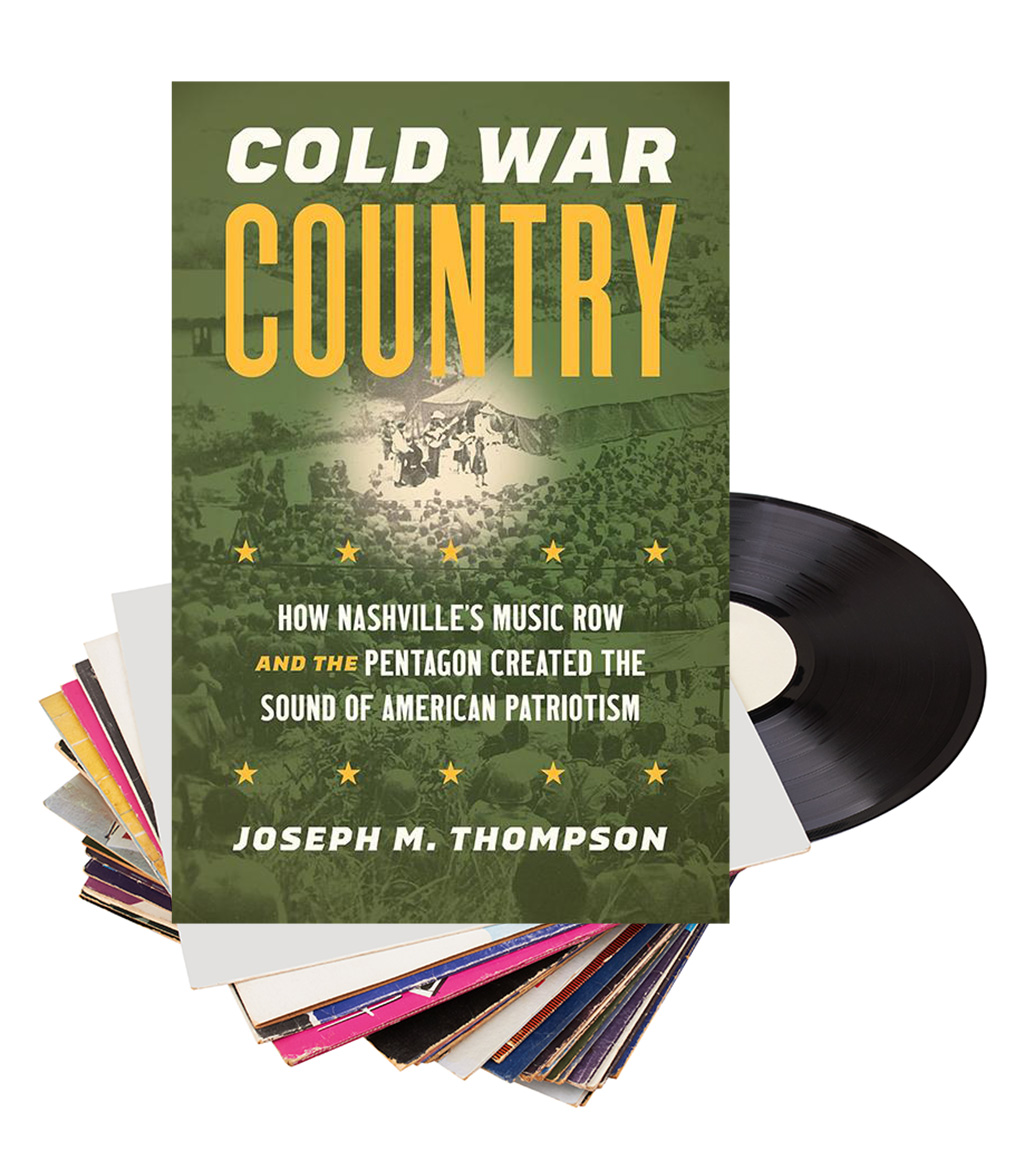
While O.B. McClinton sparked the curiosity that led Joseph Thompson to write “Cold War Country: How Nashville’s Music Row and the Pentagon Created the Sound of American Patriotism,” many iconic songs provide the soundtrack to his examination of the intersection of the music business and nationalism. These songs capture defining moments in American culture, often taking on new meanings as times change.
Thompson’s “Cold War Country” soundtrack includes:
- Hank Williams (as Luke the Drifter), “No, No Joe”
- Hank Locklin, “Geisha Girl”
- Kitty Wells, “Heartbreak USA”
- The Louvin Brothers, “The Great Atomic Power”
- Johnny Wright, “Hello Vietnam”
- Loretta Lynn, “Dear Uncle Sam”
- Tom T. Hall, “Mama Bake a Pie (Daddy Kill a Chicken)”
- Merle Haggard, “Okie from Muskogee”
- Lee Greenwood, “God Bless the U.S.A.”
- Toby Keith, “Courtesy of the Red, White and Blue (The Angry American)”