

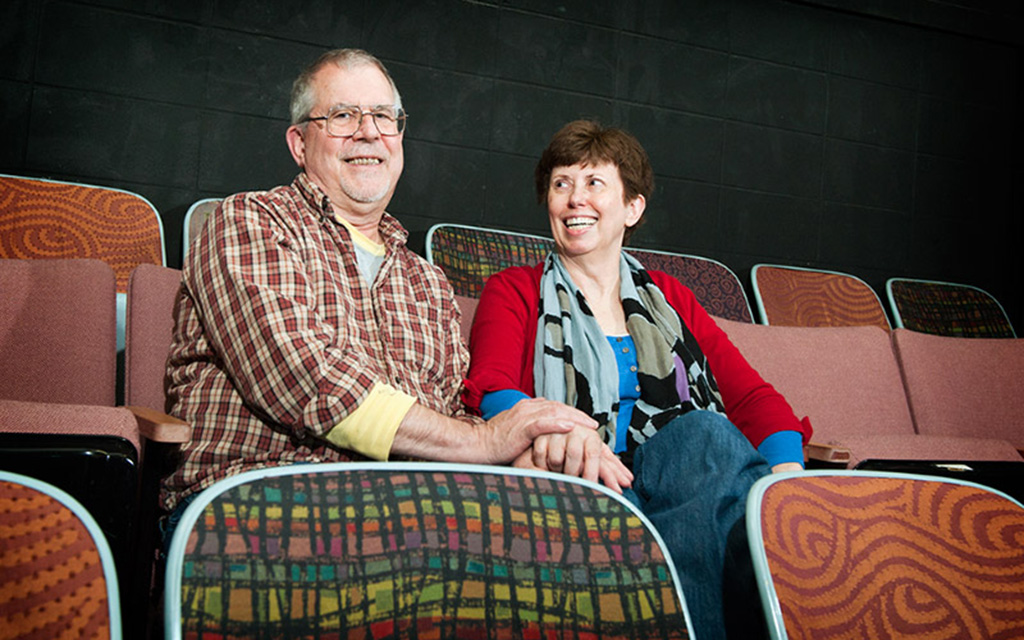
When we first moved from Idaho to Starkville, we had two challenges to overcome: learning to navigate Malfunction Junction and teaching theater at a university that didn’t have an actual theater.
The former took me a couple of years to master, but when I did, I truly felt like I had made it. I had passed the test to become an official member of the community. The latter took a bit longer, but nearly 50 years later Theatre MSU stands as a testament to the work of visionary administrators, pioneering faculty and devoted student performers. And we’re happy to have played our parts.
When I was hired in 1978, theater at MSU was essentially a two-person program. My role was to teach technical theater courses—like stagecraft and lighting—and help with scenery and lighting for several shows each year, including dinner theater productions. Jo joined me on the faculty a couple of years later as a speech instructor before moving into teaching performance and directing classes.
I liked to joke that we were the only touring company that never left town. We staged shows wherever we could find space—most often Lee Hall, the union or the Y auditorium. University President Donald Zacharias, department head Samuel Dudley, and Dominic “Dom” Cunetto, who started and led the theater program, planned to change that with a new building—the Creative Arts Complex, which later became McComas Hall and includes a dedicated theater space.
While everything came together for the new building, we dedicated ourselves to creating the strongest theater program possible using the resources we had. We had to be flexible, creative and resourceful, but managed to put on some memorable performances and grow the high school drama festival that Dom established in the 1960s.
We officially opened the McComas Hall theater in 1991 with a production of “The Matchmaker.” Once we moved into our permanent home, we were able to realize our vision of a regular season with four to five productions each year. Dom, whose vision had shaped Theatre MSU from the beginning, retired in 1991, leaving Jo and me, and later Melanie Harris, to continue to build on the foundation he built. And I’m proud of the legacy we left when we retired.
We often get asked if we had a favorite production during our time at MSU, but it’s impossible to pick just one. We had so many great memories, so many great students—it was a great ride. Now, we get to enjoy shows from the audience and marvel at what the next generation is doing.
Our stay in Starkville was only meant to be a couple of years, but this place and its people really make you feel at home. I’m proud to say that I “passed the test” to become part of this community and that we had a small part in shaping it the same way it has shaped us.
Wayne and Betty “Jo” Durst met while in graduate school at Idaho State University, where they earned Master of Arts degrees and which was Wayne’s undergraduate alma mater as well. Jo earned her bachelor’s from the College of Idaho, and Wayne also holds a Master of Fine Arts from the University of Alabama. They retired in 2012 and 2013, respectively, earning emeritus professor status. Upon their retirement, MSU established the Wayne and Jo Durst Script Collection. Housed within the MSU Libraries, it contains the scripts of their past shows, which include handwritten notes and production markings. Wayne was inducted into the Summer Scholars On-Stage Hall of Fame in 2009, and the couple received the Mississippi Theatre Association’s Cowboy Maloney Award in 2012. MTA recognized the couple again earlier this year, renaming two of its annual DramaFest awards in their honor: The Betty “Jo” Durst Directing Award and the Wayne “Dur” Durst Award for Technical Achievement.