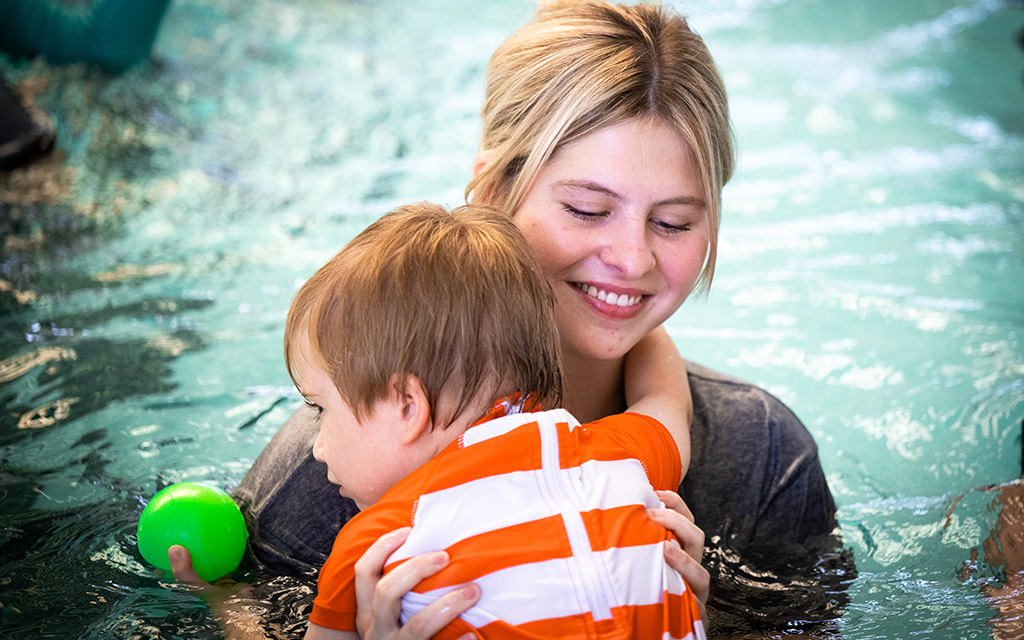
MSU’s Adapted Swim Camp provides lifesaving skill, invaluable community outreach
When my family returned to Mississippi in 2023, our home had a pond in the backyard. What was initially a wonderful feature of the property soon became cause for concern when our son Malakai tried to walk straight in without fear of what may be in it or how deep the water was.
He was only 20 months old at the time, but it took only seconds for him to beeline toward the pond when he noticed it. Thankfully, the mud slowed him down and my husband got to him before he went too far. Still, I worried. What if my husband hadn’t been there? What if Kai had escaped the house and gone to the pond alone? It’s something any mother would fear.
That fear grew when Kai was diagnosed with autism at 2 1/2 years old. See, children on the spectrum are often drawn to water, but they may not understand its dangers. My fear only grew as I continued to see stories about autistic children who eloped and drowned because of their fascination with water.
I earned lifeguard certification when I was 15, so I already knew how dangerous water can be, and I’ve always been a big proponent of starting swimming lessons early for my children, but now it was an even bigger priority.
The problem is that traditional swim lessons, especially ones in group settings, can be extremely challenging for those on the autism spectrum or with other physical or mental disabilities. Thankfully, we found the Mississippi State University Adapted Swim Camp.
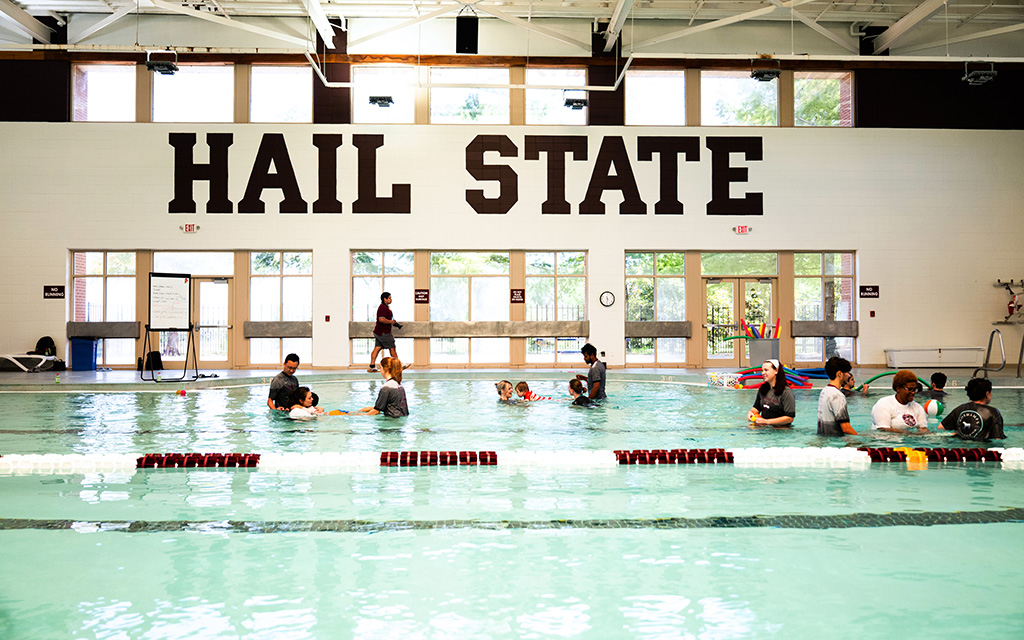
The camp provides individualized swimming instruction for children and adults with disabilities, helping participants develop skills, independence and confidence in the water.
Kai first joined the adapted swim program at 3. Since that time, I’ve seen him grow not just in his swimming abilities but also in his confidence and comfort with water—starting with knowing he needs permission before jumping in. Watching him develop those skills has been incredibly rewarding as a parent.
The counselors and instructors are truly amazing with the children. Their patience, kindness, encouragement and ability to adapt their teaching methods to meet each child’s individual needs creates an environment where the children can thrive. They understand that every child learns differently and take the time to build trust and confidence while teaching critical water safety and swimming skills.
I witnessed their dedication with Kai’s first lesson—it was horrible. He fought tooth and nail to not go with the volunteers to the water. That’s not uncommon with autistic children his age. He didn’t want to go with the strangers and was frustrated that he couldn’t communicate what he wanted since he is still nonverbal. But the instructors were so patient with him and tried different strategies to teach him, while also working on ways to calm him. Through their persistence, his entire attitude toward the lessons changed. By our next camp, he couldn’t wait for the volunteers to come get him. It is obvious the instructors genuinely care about the success and well-being of every child they work with.
MSU’s Adapted Swim Camps provide something that simply cannot be replicated in a standard program. Their ability to meet each child where they are, adapt to individual needs and create a safe, supportive learning environment is remarkable, and it truly fills a critical need as individuals with disabilities need access to water safety education just as much as—if not more than—neurotypical, physically able individuals.
This inclusive opportunity for children and adults allows them to gain confidence, independence and safety skills that can ultimately save lives, and I am so grateful to have this resource at Mississippi State.
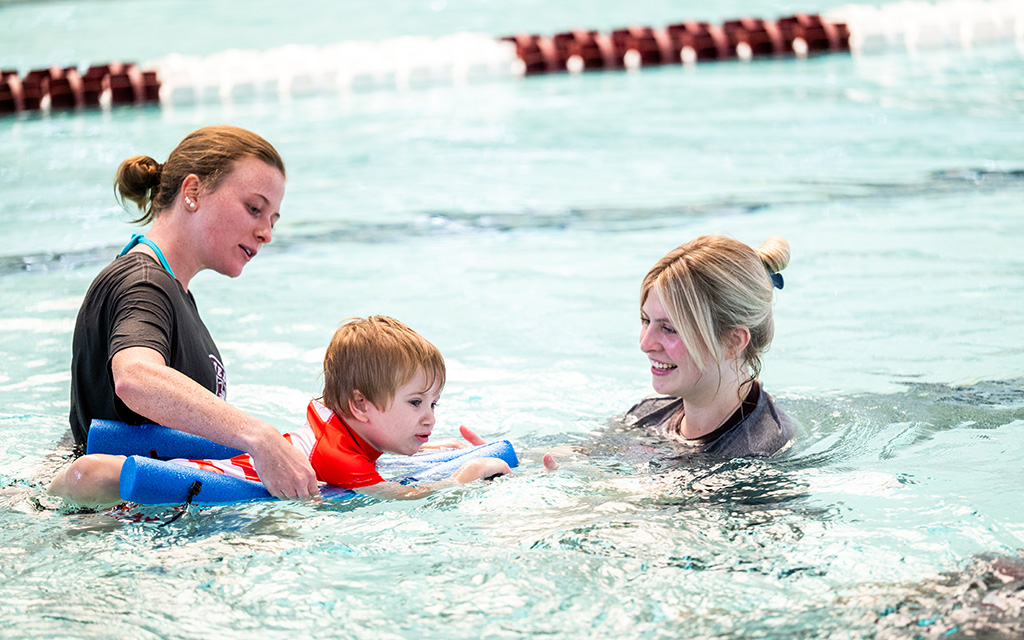
Mississippi State’s Adapted Swim Camp pairs participants with student and community volunteers who tailor activities and instruction to each individual’s abilities and needs.
Mississippi State University‘s Adapted Swim Camp
Mississippi State hosted its first Adapted Swim Camp in 2023. Since that time, scores of individuals with mental and physical disabilities have learned water safety and swimming techniques through the program.
Gregg Twietmeyer, a kinesiology professor who leads the program, said spots in the camp fill up quickly and that kind of interest shows the importance of providing opportunities for individuals and families to safely add more activity to their lives.
“Physical activity is fundamental to human flourishing,” Twietmeyer said. “We’re not trying to train the next Michael Phelps. We just want people to be comfortable and safe in the water to help broaden their opportunities for an active life.”
Administered through the Department of Kinesiology, the camp is funded through a grant from the Mississippi Council on Developmental Disabilities. The camp has also received annual support from the Mississippi Department of Rehabilitation Services, the Knights of Columbus, MSU Campus Recreation, Deep South and Company, Civitans, and several private benefactors.
MSU’s Adapted Swim Camp is open to ages 3 and up for $100 per weeklong session, with full scholarships available for those with financial need. To ensure a quality, individualized experience, as well as the safety of participants, each session of the camp is limited to six participants. MSU students and community volunteers serve as volunteer instructors, while two kinesiology graduate assistants, who are certified adapted aquatics instructors, oversee the lessons to make sure every volunteer is following proper safety and instructional practices and to help make additional accommodations for participants where needed.
Twietmeyer said the camps provide invaluable experience to kinesiology students by allowing them to put theory into practice.
“Our discipline focuses a lot on theory,” he explained. “We talk about movement, but we don’t actually do it. We have to have both. I can stand at a chalkboard and tell students about the benefits of swimming for somebody with autism, but you put them in the pool with an autistic child—where they can see that child grow in confidence and skill—and that’s a very different thing.”
It’s an experience MSU students take with them after they graduate. This summer, Twietmeyer partnered with three-time Mississippi State alumna Alana Turner to launch an adapted swim program at the University of Southern Mississippi.
Among the first volunteers with MSU’s Adapted Swim Camp, Turner is now an assistant professor at USM. This year, she returned to Starkville to earn certification as an adapted aquatics instructor. Mississippi State then shared its staff and experience with Southern Miss to help the Golden Eagles host their own camp.
“There really is a dearth of programs like this in our region, so we wanted to plant a seed down there,” Twietmeyer said. “At Mississippi State, we want to help better our state, and through this program and this partnership we are broadening the opportunities for people with special needs in Mississippi.”
Personal essay by Natasha Cundy with additional reporting by Susan Lassetter, Photos by Grace Cockrell