MSU researcher fills crucial void for Southern Christmas tree farmers
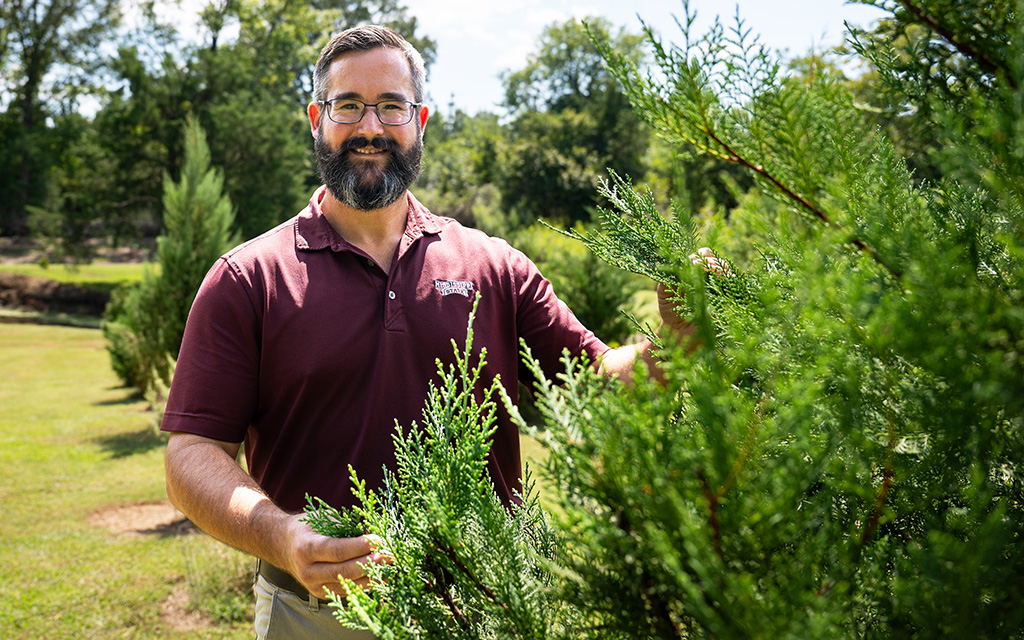
Four years ago, Joshua Granger and his two young sons walked onto the family’s land with a shovel, a few dozen seedlings and a plan. That day, they converted seven-and-a-half acres of Mississippi dirt into a burgeoning family tradition: their own Christmas tree farm.
“I knew absolutely nothing about planting Christmas trees when I started,” he said. “I wanted to cultivate a few trees myself and see firsthand what our local growers are experiencing. I’ve always believed that if you’re going to research something, you should have some practical experience with it rather than just studying it from a distance.”
Since that initial planting, what started as a modest plot of a few dozen saplings has grown into a robust experimental testing ground of more than 700 trees and 250 varieties on Granger’s property.
An assistant professor in forestry at Mississippi State, he is using his stand of trees as a living laboratory to support multidisciplinary research being revitalized at MSU to help bolster an underserved Mississippi crop.
Growing Christmas trees, he said, requires a four-to-five-year commitment of continuous shearing, pruning, weed control and disease prevention, all while predicting customer demand years in advance.
“Working in forestry, you understand the ups and downs of farming, but I have a newfound respect for Mississippi’s Christmas tree farmers,” Granger admitted. “I planted my trees just for fun, but for these landowners, their trees represent their livelihood. There’s a tremendous amount of hard work, time and education that goes into growing and caring for them, and I’ve gained a much greater appreciation for what that means.”
The Magnolia State challenge
Mississippi’s peak Christmas tree production came in the 1980s, with nearly 450 tree farms producing 330,000 trees. By 1997, the number of farms had dropped to 170 as a national oversupply of the seasonal crop drove most of the small-producing farms out of business.
At that same time, researchers retired or aged out of the business, and academic research into the crop ground to a near halt. Meanwhile, big-box retailers continued stocking standard cool-climate conifers like Fraser, Douglas and Canaan firs—species suited for northern climates that can’t sustain the summer heat, further narrowing the market for locally produced trees.
“You plant a Fraser fir in Mississippi, and it will do just phenomenally until about June,” Granger said. “Then the first day it gets hot and humid, it’ll die.”
Even heat-tolerant alternatives like Leyland and Arizona cypresses face continuous pressure from the Mississippi climate. High humidity is a breeding ground for needle blights, cankers and fungal diseases that can wipe out years of effort in a single season.
Recognizing that no single discipline could solve these complex agronomic and economic challenges, Granger helped rally a collaborative network of experts across MSU’s campus.
A high-tech approach
Among those partners is Joby Czarnecki, an associate research professor at MSU’s Geosystems Research Institute. With a background in precision agriculture, she is leading a three-year USDA project aimed at delivering practical tools directly into the hands of small-scale producers.
Leveraging spatial technology, a cross-disciplinary team is developing early disease-identification frameworks and targeted management plans so farmers can protect their crops without overspending on expensive crop treatments.
“When growers see browning on a tree, they need to know if it’s a fungal disease, drought or just natural dieback,” Czarnecki explained. “Instead of applying treatments based on guesswork, we are identifying optimal timing so they might only have to do it three times instead of 10.”
The second portion of the grant supports the team’s work to identify optimal planting zones for specific species.
“In forestry, you have to put the right species on the right site,” Granger said. “If you put a tree that requires lots of water in a drought-prone area, or a drought-tolerant tree in a wet area, neither one is going to make it.
“Essentially, our work through this grant is helping farmers plant the right trees at the right sites and care for them efficiently,” he added.
Roots in the community
Granger said the team’s research hits at the heart of Mississippi State’s land-grant mission: serving local landowners with evidence-backed practices. But the work isn’t just helping growers remain profitable—it’s protecting a community resource.
Czarnecki said these family-owned farms serve as vital agritourism hubs. They bring communities together for hayrides, pumpkin patches and holiday traditions that connect consumers directly to agricultural production.
“The energy of these Christmas tree growers is very different than other farmers we’ve worked with,” Czarnecki said. “There hasn’t been a lot of recent research in their business, so they are so excited to participate. We’ve received the sweetest letters from landowners who want to maintain their farms and build something that will last for their children.”
As for Granger and his children, they regularly work their crop, shaping branches, managing weeds and evaluating which species perform best under local field conditions—hard work that will be worth the reward this holiday season when they walk the property with a hacksaw in hand to harvest the best-looking Leyland or Arizona Cypress for their home.
While he says he started his Christmas tree grove for fun, it’s given him a deeper appreciation for producers and the dedication they have to growing what will become the centerpiece of many families’ holiday celebrations.
“I’m doing this because it’s fun for my family, but it’s these farmers’ livelihood,” Granger said. “By engaging in meaningful conversation with these landowners, we’ve given them a voice, built relationships of trust and provided a direct point of contact where they can bring their questions, concerns and ideas.
“We help farmers do what they need to be successful by giving them the knowledge, skills and abilities to do what they do,” he said.
By Mary Torrence-Pollitz, Photos by Emily Grace McCall
Keeping it Fresh
Keeping a cut tree fresh throughout the holiday season requires a few simple but important steps.
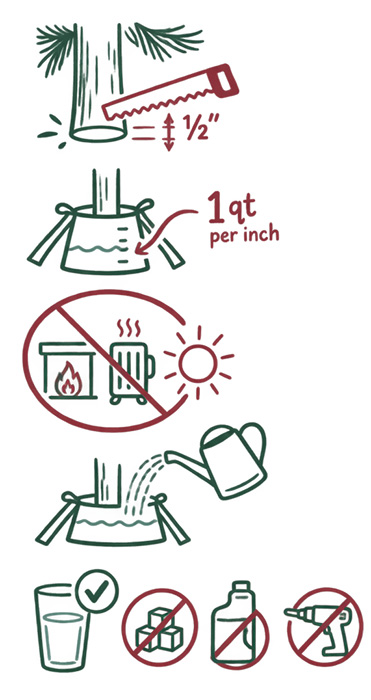
Trim half an inch straight across the base of the trunk before setting it up and place it in water immediately to prevent sap from sealing the cut.
Choose a stand that holds at least one quart of water per inch of trunk diameter.
Keep cool. Make sure the tree is far from fireplaces, space heaters, heating vents and direct sunlight to prevent premature drying.
Ensure the water level never drops below the base of the trunk. Check water levels daily.
Avoid the Christmas tree myths. Stick to plain tap water in the stand, skipping additives like sugar, bleach or commercial preservatives. Additionally, avoid drilling holes into the base of the trunk, as this weakens the tree’s support without increasing its water absorption capacity.