

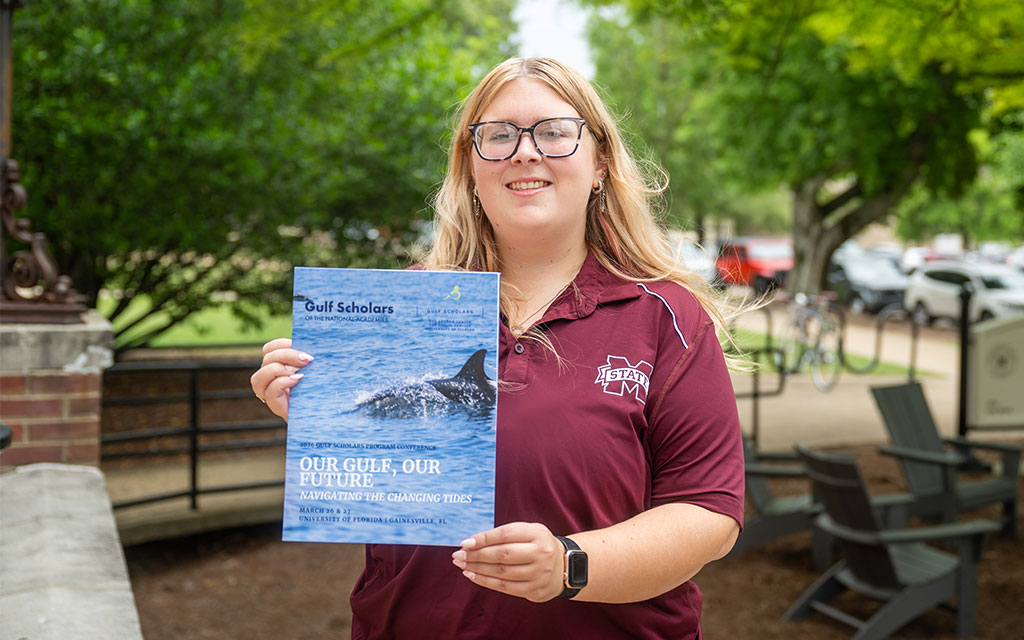
Gulf Scholars Program provides holistic education to burgeoning ‘change agents’
A degree from Mississippi State can take a graduate anywhere in life, but Riley Kempner wants her Bulldog education to take her back home to the Gulf Coast.
“Growing up on the Coast, you really have a personal connection with the land, water and people,” the senior geoscience major from Moss Point said. “It’s very important to me because I want to protect the region—my home—so my kids and grandkids can one day have the same experiences I had growing up.”
A recipient of the Mississippi Gulf Coast Alumni Chapter Scholarship, Kempner enrolled in MSU’s Gulf Scholars Program, an initiative housed in the College of Integrative Studies that provides aspiring coastal professionals a well-rounded, tailor-made education focused on the region.
The program launched in 2023 thanks to a five-year award from the National Academies of Sciences, Engineering and Medicine. MSU developed specific classes central to understanding the Gulf Coast through various lenses, including those focused on history, multimedia storytelling and problem-solving through purposeful team-building and design.
Jamie Dyer, dean of the college, said it is truly an academic collaboration designed to serve students and a part of the state that faces unique challenges.
“If we want to take care of what matters, we have to first define why it matters,” Dyer said. “True problem-solving requires a holistic approach. I want this program to develop change agents for the entire area, from Texas to Florida. When our future scientists take courses focused on the social sciences and human aspects of the Gulf Coast, they’re going to be more well-rounded experts who excel in critical thinking and provide pathways to solutions that truly make a difference.”
Associate Professor Jim Giesen, a Grisham Master Teacher, leans into this latitudinal thinking—asking students to look at things in a different light for his course on the history of the Gulf Coast.
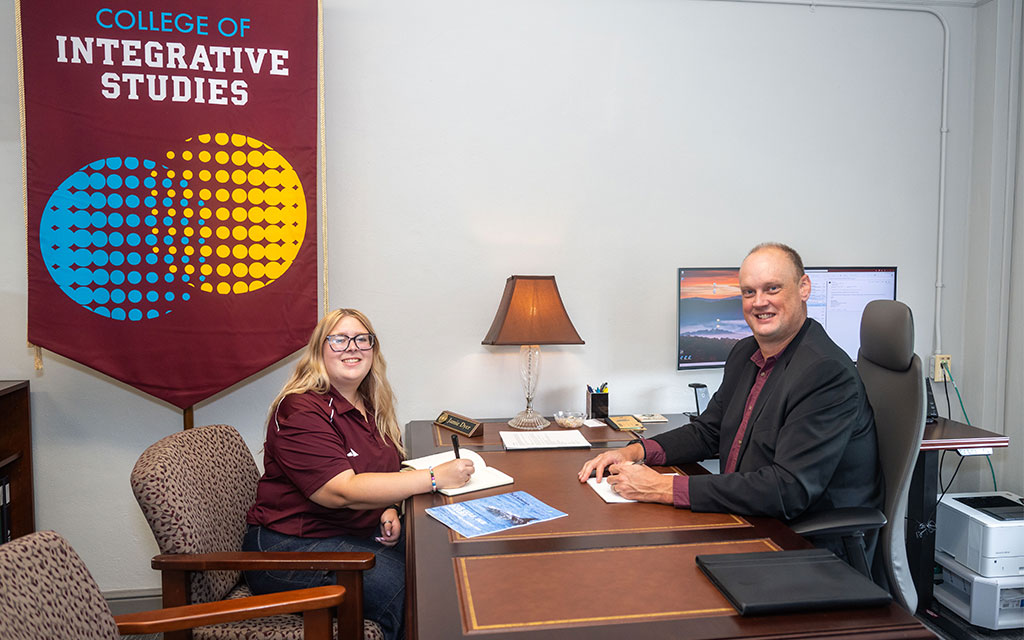
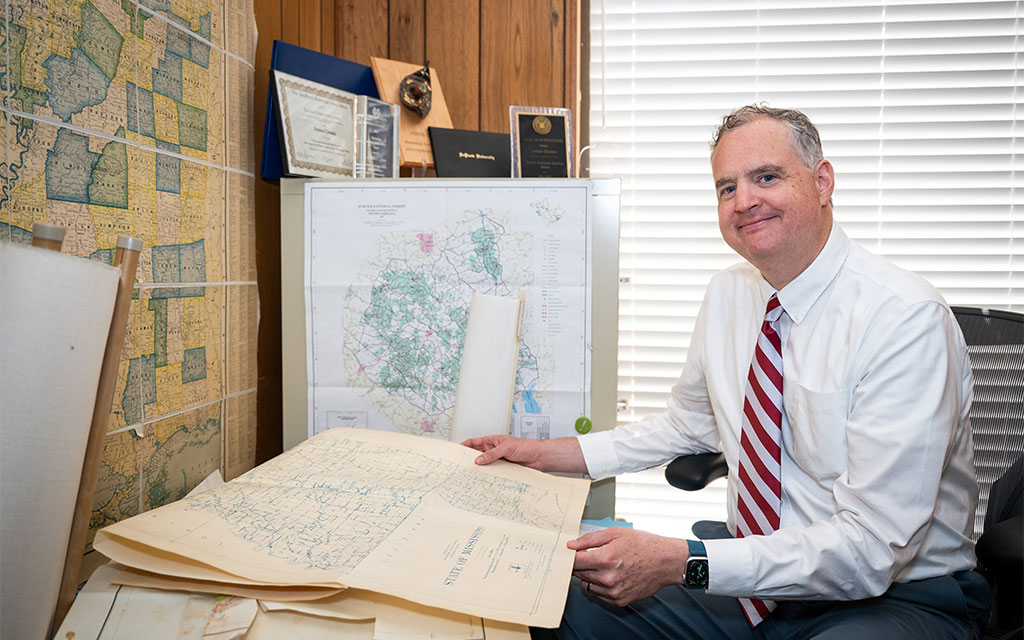
Gulf Scholars Program faculty help students explore the Gulf Coast through interdisciplinary learning. Associate Professor Jim Giesen, top, teaches a course on the history of the Gulf Coast, while Jamie Dyer, dean of the College of Integrative Studies, bottom right, meets with Gulf Scholar Riley Kempner.
“History makes us better citizens because it gives us a sense of empathy for other people and helps us see how interconnected all of these different forces—both local and very far away—are to getting us to where we are today,” he said. “This can be particularly helpful for STEM students.
“The best scientists often have humanities backgrounds,” he continued. “When you see students put history and science together, their eyes open. It’s my hope that they take history with them into their science classes and start to connect the ways that all these forces interact on the Gulf Coast.”
The Gulf Scholars Program is working toward developing a minor available to students across campus, which will be a major milestone in the program’s growth. Dyer said he’s hopeful to continue building pathways to additional degrees, minors and certifications in the future. He also wants to use his position as the associate director of the Northern Gulf Institute, a NOAA Cooperative Institute led by MSU, to help link undergraduates, who historically are not involved in as much hands-on research, to opportunities at the research center.
“My goal is to get undergraduates aware of interdisciplinary thinking and research,” he said. “When we normalize these things earlier in their academic careers, the more benefits they receive. When you see the possibilities, you can then see yourself achieving them.”
With the establishment of the College of Integrative Studies in 2025, MSU remains at the forefront of true collaboration by creating interdisciplinary academic pathways and offering students new ways to think about the world and its future.
“We have advisors and faculty who listen to students and say, ‘It’s not about what you want a degree in; it’s about what you’re interested in,’” said Dyer, who comes from a diverse academic background including physics, hydrology and meteorology.
“Our goal is to make sure we have programs that benefit students no matter where they’re coming from or where they’re going.”
By Carl Smith, Photos by Emily Grace McCall
BE OUR GUEST
New MSU tourism minor places Bulldogs at the center of Mississippi’s fourth-largest industry
From the Delta to the Coast to Mississippi’s College Town, the tourism industry brings people, and their spending money, to the Magnolia State. Now, a new Mississippi State minor in tourism and destination development will equip Bulldogs for vital roles in this growing Mississippi industry and economic driver.
Drawing on expertise from across campus, the 15-credit-hour minor housed in MSU’s College of Integrative Studies provides practical skills in the classroom and hands-on learning experiences with tourism-focused services including visitor centers, hotels and event-planning organizations.
“This minor prepares students to become highly capable, industry-ready professionals by combining foundational knowledge with immersive learning,” said program director Rachael Carter, an Extension specialist with MSU’s Center for Government and Community Development. “They’re gaining experience shaping destinations, developing authentic visitor experiences and promoting places in ways that drive engagement and repeat visitation.
“Through internships and applied projects, they build essential skills in leadership, communication and problem-solving—graduating with the experience, confidence and professional portfolio needed to deliver immediate value to employers and communities,” she added.
In 2024, Mississippi welcomed an estimated 44.2 million visitors, whose spending generated almost $12 billion for the state economy and supported more than 136,000 jobs—making tourism the state’s fourth-largest industry.
Visit www.cois.msstate.edu/academics/minors/minor-tourism-destination-development to learn more about the new program.