

MSU ignites young minds through new STEAM discovery center
What do constellations, a wind tunnel and a robotic dog have in common?
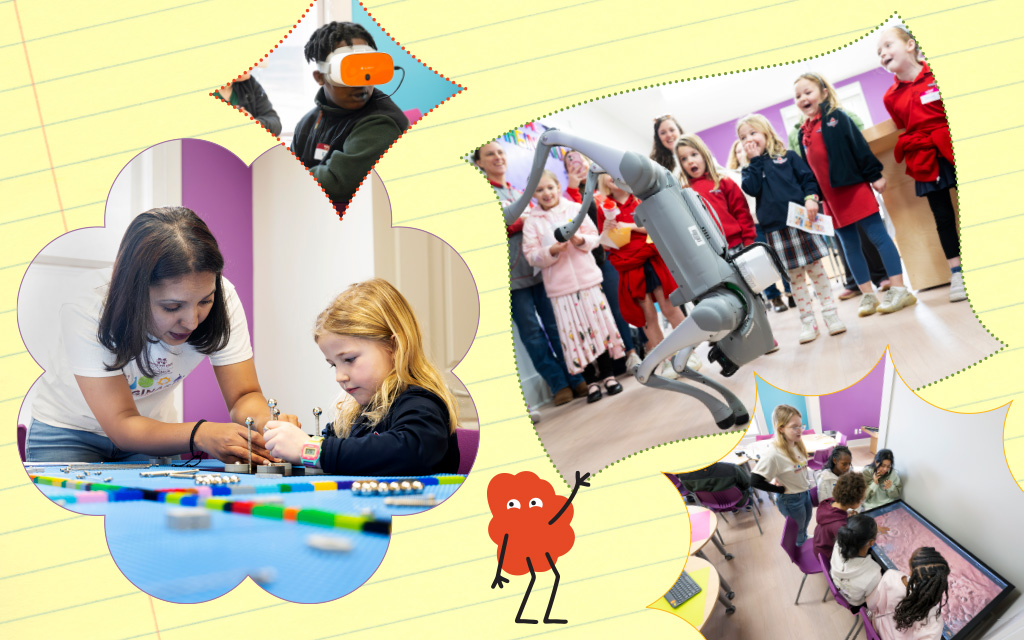
All three are part of the hands-on learning and exploration taking place at Mississippi State University’s new Imaginarium: Creativity and STEAM Discovery Center.
With a name that stands for science, technology, engineering, art and math, the STEAM center is more than a science center—it’s a creative laboratory that encourages children to become problem-solvers, designers and innovators. From building earthquake-resistant structures to watching drawings come alive on an interactive wall, the center features guided activities for children in kindergarten through eighth grade.
Now open on MSU’s campus, the Imaginarium also serves as a dynamic teaching and research space, providing valuable experiential learning opportunities for students and paving the way for collaborative partnerships across the nation.
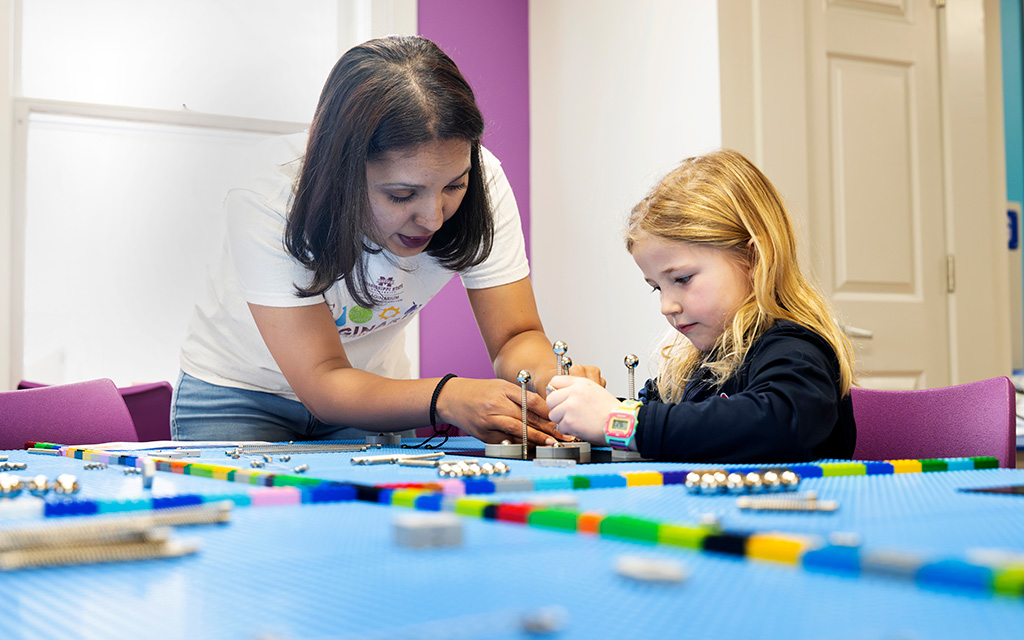
Akshaya “Maya” Godavarthi, a master’s student in educational psychology from Vijayawada, India, helps a young visitor explore hands-on STEAM activities at Mississippi State University’s Imaginarium: Creativity and STEAM Discovery Center.
A Dream Come True
The Imaginarium was cofounded by Sareh Karami and Mehdi Garemani, educational psychology faculty members in MSU’s College of Education. When the couple moved to Starkville, they noticed the absence of a local science center and dreamed of filling that void. Karami said they loved taking their daughter to science centers and wanted other families to experience the value of immersive-learning.
In fall 2025, that dream became a reality with the opening of the Imaginarium, which gives children in Starkville and other areas of the Magnolia State access to hands-on STEAM activities that foster curiosity, learning, creativity and critical-thinking skills.
“We created the Imaginarium so every child in our community could experience the excitement of discovery, regardless of where they live or what resources they have,” Karami said. “Not every family can travel two hours to a STEAM center, but now they can have that same opportunity right here.”
Featured exhibits include a car track, magnet wall, earthquake simulation table, creative coding station, virtual reality and much more. It is open for field trips and private events with plans to offer regular public hours in the future.
The center is the expansion of the Imaginarium Express, a traveling makerspace initiated by Karami and Garemani in 2023. The mobile unit continues to serve schools, libraries and rural communities throughout the state, with the goal of reaching children who may not otherwise have access to STEAM learning opportunities.
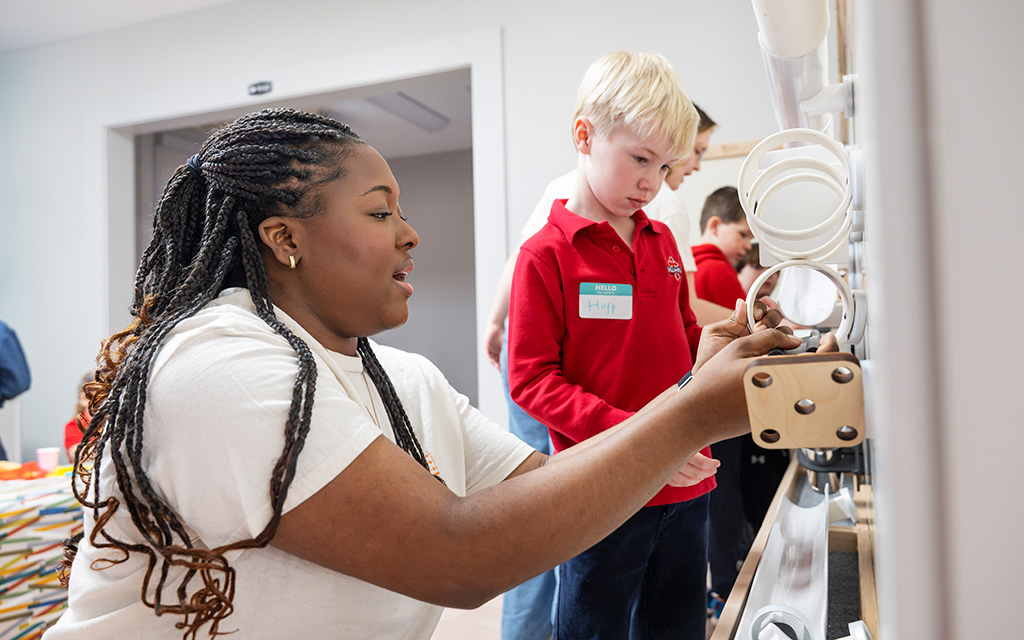
Grace Austin, an educational psychology graduate student from Eupora, guides a visitor through an interactive exhibit at MSU’s Imaginarium, where university students help lead hands-on learning experiences for visiting children.
Learning and Growing
As children are learning at the Imaginarium, so are the MSU students working with them. The center provides educational psychology students with meaningful hands-on experiences as they develop collaborative activities for children, lead them through those exercises and collect data for research purposes.
Grace Austin, a graduate student from Eupora, said the Imaginarium has helped her tremendously, especially with learning how to adapt exhibits for children with a wide range of learning needs. But her favorite parts are the light-bulb moments she gets to witness.
“Sometimes kids come in and say, ‘I don’t know if I can do this,’ or ‘I don’t understand this.’ Seeing that aha moment when they finally get it and grow from it—that has been one of my favorite experiences,” Austin said. “I love seeing the joy on their faces when they complete the activities.”
For Akshaya “Maya” Godavarthi, a master’s student from Vijayawada, India, the best part is what takes place behind the scenes.
“Before a field trip, we brainstorm ideas, have planning sessions and test out new activities,” Godavarthi said. “After the field trip, we discuss what worked and what didn’t. We give each other suggestions and try to eliminate what is not working. I really enjoy the behind-the-scenes process of brainstorming, testing and refining activities.”
Godavarthi said the Imaginarium has helped her grow as a researcher, leading her to further her education at MSU by pursuing a doctoral degree.
While the Imaginarium is anchored in educational psychology and greatly benefits students like Austin and Godavarthi, other MSU programs—such as industrial engineering, architecture and secondary education—are seeking to collaborate with the center. Institutions outside the state are also taking notice and reaching out to the Imaginarium team to join forces. From research to activity development, collaborations are already underway with the University of Alabama, Ball State University and the Da Vinci Science Center in Allentown, Pennsylvania.
The Power of Possibility
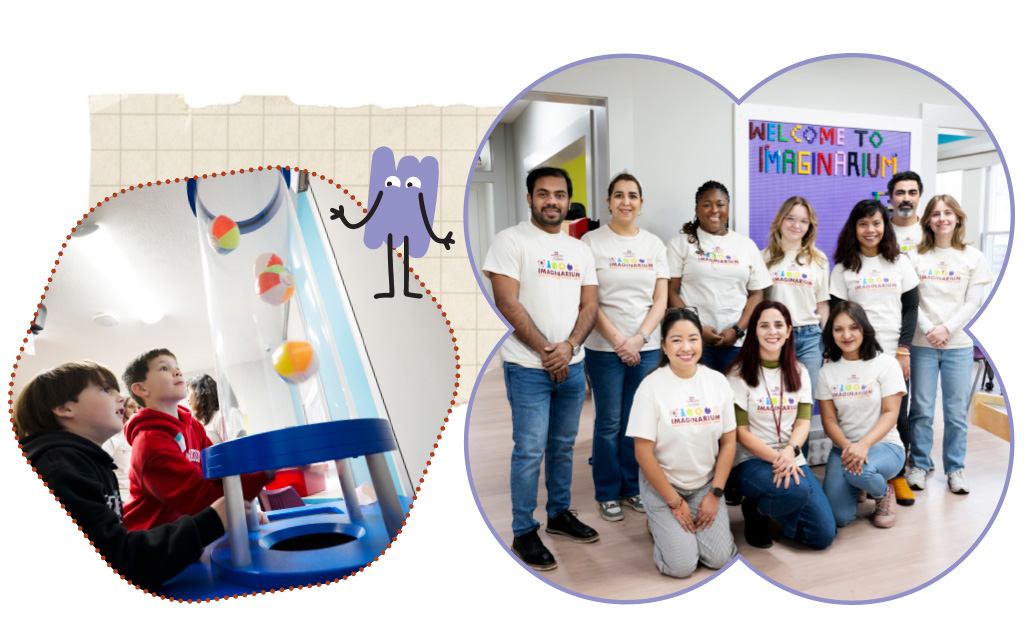
As Karami and Garemani fulfill the university’s mission of teaching, research and service through the Imaginarium, their hope is future generations—perhaps even future Bulldogs—are inspired by what they learn at the center and empowered to choose a STEAM field one day.
“At the Imaginarium, we want every child to leave feeling curious, confident and excited to learn,” Garemani said. “Whether it’s their first time using robotics or building a tower that finally stands, they learn it’s OK to make mistakes and try again. Creative problem-solving teaches us learning isn’t about getting it right the first time—it’s about being brave, trying new things and growing through each step.”
By Bethany Shipp, Photos by Beth Wynn
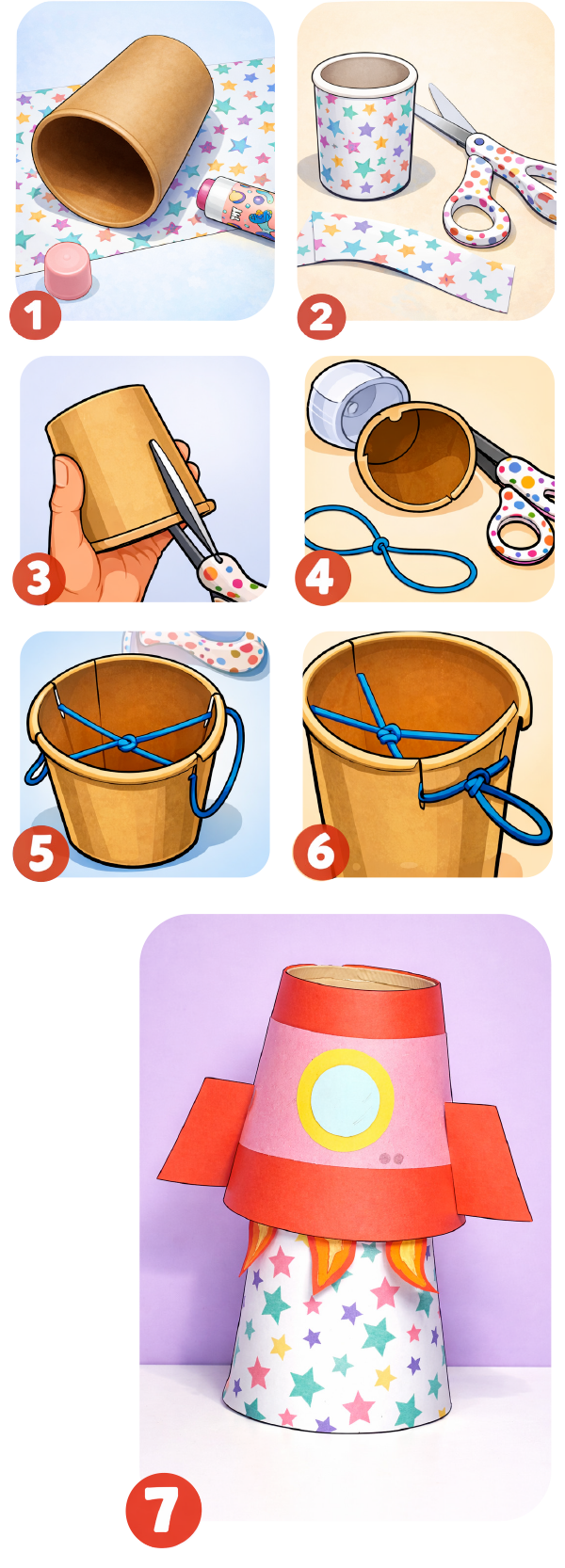
STEAM AT HOME | Paper Cup Rocket
Using simple craft materials, you can build a paper cup launcher and a rubber-band-powered paper rocket. When you launch it, you’ll see how force and motion work together to make the rocket fly.
Materials
- 2 paper cups
- 2 rubber bands
- Scissors (adult help recommended)
- Glue stick
- Decorative paper, pencils, markers or paint
Steps
- Decorate the launcher. Start with one paper cup, which will be your launcher. Decorate it using markers, colored paper or drawings—anything you like.
- Trim if needed. If you glued colored paper onto the launcher cup, carefully cut off any extra so the edges are neat and smooth.
- Prepare the rocket. Take the second paper cup. Using scissors, make four small cuts near the rim—two on one side and two on the opposite side (adult help recommended). This cup will become the rocket.
- Link the rubber bands. Take the two rubber bands and loop them together to make one longer rubber band.
- Add the rubber bands to the rocket. Pull the linked rubber bands through the cuts in the rocket cup, following the pattern shown in the picture.
- Secure the bands. Tie the rubber band ends on both sides so they stay firmly in place inside the rocket cup.
- Hide and decorate the rocket. Cover the outside of the cup to hide the rubber bands but leave the opening of the cup uncovered. Decorate the sides using colored paper, drawings or designs.
Launch time!
Place the rocket cup upside down on top of the launcher. Gently push the rocket down, then release to watch it fly into the air!